
Agent-First Companies: The $52B Execution Gap, MCP Hits 97M, Cloud Acquirers Circling

“We shape our tools, and thereafter our tools shape us.” – John Culkin

Get Full Access to Trends Pro

❓ What You’ll Learn

  • Why do 75% of AI agent tasks fail on basic business operations?
  • How does compound reliability math create structural demand for purpose-built primitives?
  • Which primitives (browser, search, memory, compute, payments) are growing fastest?
  • Where can founders build in the white space between today’s primitives?
  • What can the cloud-native playbook teach founders about the Agent-First trajectory?
  • Why are cloud providers likely to start acquiring Agent-First startups?
  • Why does per-seat SaaS pricing break when agents do the work of 10 people?
  • What makes agent autonomy both a selling point and a liability?


💎 Why It Matters

The bottleneck in AI shifted from intelligence to execution.


🔍 Problem

AI agents break when they touch the real world.

Each integration is custom, fragile and expensive.

More steps, more failure.


💡 Solution

Agent-first companies that build ready-made blocks for agents to operate in the real world.

One block per action: browse, email, pay, compute, remember, speak, search.


🏁 Players

Compute and Sandboxes

  • Daytona • Agent-first compute infrastructure with sub-30ms sandbox provisioning
  • E2B • Sandboxed cloud environments for agents
  • Agent Computer • Cloud virtual sandboxes with sub-second spin-up for persistent agent workloads

Browser Access

  • Browserbase • Headless browser infrastructure for agents
  • Browser Use • Open-source browser automation for agents
  • Hyperbrowser • Browser API with built-in scraping, session recording and agent orchestration

Search and Web

  • Exa • Neural search API built for agents
  • Firecrawl • Web crawling API converting any URL to LLM-ready data


🔮 Predictions

  • Cloud providers will acquire Agent-First startups as the category proves out. The pattern mirrors cloud-native acquisitions.
    • IBM spent $11B on Confluent to solve the “agentic AI puzzle”. Agent-First companies are natural next targets.
    • E2B has 88% of Fortune 100 signed up. Exa hit a $700M valuation. These are acquisition-ready assets.
    • AWS, Google and Microsoft all have agent infrastructure gaps that organic development won’t close fast enough.
  • MCP will become the de facto integration standard. It will commoditize connections and shift value to execution quality.
    • MCP grew from 100,000 downloads (Nov 2024) to 97M monthly SDK downloads by 2026.
    • Tens of thousands of MCP servers exist. A standardized plug doesn’t make all appliances equally good.
    • OpenAI, Google DeepMind and every major provider adopted it. The Linux Foundation accepted it as vendor-neutral.
  • Usage-based pricing will replace per-seat as the default for agent-adjacent software. Per-seat breaks when an agent does the work of 10 people.
    • Intercom already charges $0.99 per resolved issue instead of per seat.
    • Software companies anchored to seat counts will face margin compression as agents handle more work.
    • Every Agent-First company uses usage-based or per-API-call pricing. Browserbase bills by session minutes.


☁️ Opportunities

    • Launch an observability platform for multi-primitive agent workflows. When an agent uses browser, search, memory and email in one workflow, debugging has to check 4 dashboards.
      • This is the Datadog opportunity for agents. A single platform tracing execution across multiple primitives.
      • The compound reliability problem (85% per step = 20% success at 10 steps) makes end-to-end tracing essential at production scale.
      • Build an OpenTelemetry-compatible trace layer for agent workflows. Offer it free to Agent-First startups, upsell enterprises on the dashboard.
    • Ship an agent cost management platform. Usage-based pricing across a dozen providers creates a cost attribution problem that didn’t exist for human users.
      • The wedge: show teams what their agents actually cost per task. Own the billing data, own the optimization recommendations.
      • This is the CloudHealth opportunity for agent infrastructure: track per-workflow cost across providers, set budgets, alert on anomalies.
      • A single agent workflow might burn through sessions (Browserbase), search queries (Exa), memory calls (Mem0) and email sends (AgentMail). Each billed separately.
    • Build an identity and access management layer for AI agents. Every enterprise deploying agents needs to answer: who is this agent, what can it access, who authorized it?
      • AI leaders cite compliance and risk management as primary adoption barriers.
      • Current OAuth flows assume a human at a browser. No standalone company owns this layer and the compliance gap will widen as agent deployment scales.
      • The wedge: OAuth-compatible agent credentials. Start with companies already deploying agents (E2B’s Fortune 100 customers, Browserbase’s 1,000+ orgs).
    • Own vertical agent primitives for regulated industries. Current players build horizontal primitives. Healthcare, legal, financial services and real estate need domain-specific ones.
      • Start with one regulated industry where agent adoption is high and integration pain is acute.
      • Healthcare agents need HIPAA-compliant patient record access. Legal agents need court filing APIs. Financial agents need trading APIs with compliance controls.
      • Each vertical has regulatory requirements that horizontal providers will likely skip. The vertical player builds compliance once and sells to every agent in that industry.


    🏔️ Risks

    • Model Provider Bundling • OpenAI, Google and Anthropic could build agent primitives into their platforms, squeezing margins for standalone providers.
    • Integration Fatigue • Enterprises already drowning in APIs may refuse to add 5-10 more agent-specific vendors.
    • Regulatory Freeze • AI laws could slow enterprise agent deployment, shrinking demand for agent infrastructure across the board.
    • Pricing Volatility • Usage-based revenue is hard to predict, making enterprise procurement and investor valuation difficult.


    🔑 Key Lessons

    • The bottleneck shifted from intelligence to execution. Models can reason, plan and write code. The $52B opportunity is in making them act.
    • The execution gap widens as agents get smarter. Every leap in model capability increases demand for execution infrastructure. Agent-First companies are long the capability curve.
    • Usage-based pricing is on the rise but hybrid is the path to enterprise.Twilio, Stripe and AWS all navigated this transition. The playbook is well-documented.


    🔥 Hot Takes

    • The first company to reach $1B in revenue selling exclusively to AI agents (zero human customers) will come from this category.
    • “Agent Platform Team” will become a standard enterprise role within 3 years, mirroring the DevOps and Platform Engineering trajectory.
    • The real money in this space won’t be in primitives. It’ll be in the orchestration layer that stitches them together. Whoever builds the “Kubernetes for agents” captures the platform tax.


    😠 Haters

    “These are just APIs with a buzzword. What makes them ‘Agent-First’ instead of just APIs?”
    Agent-first companies are fundamentally different when the user is a machine instead of a human. Adding an MCP server to an existing API isn’t Agent-First. Rebuilding from scratch for non-human users is.

    “Agents don’t build habits or loyalty. They’ll switch providers with a config change.”
    True for commoditized connections. False for execution quality. Finding a provider that maintains 99.99%+ success rates at scale is hard. Switching costs live in reliability, not integration.

    “The more capable agents become, the larger the blast radius when something goes wrong.”
    This is the value of purpose-built blocks. They include guardrails: rate limits, spend caps, audit logs and human-in-the-loop checkpoints. The liability concern drives demand for exactly this infrastructure.


    🔗 Links

    1. Enterprise Agents Have a Reliability Problem • Why 92.5% of production agents still deliver output to humans instead of acting autonomously and what the reliability gap means for infrastructure builders.
    2. Agent-First Architectures • Dan Shipper’s canonical definition of Agent-First architecture. Five technical principles that distinguish Agent-First from API wrappers.
    3. The Agentic Infrastructure Overhaul • Why agents failed in 2025 was not intelligence but plumbing. The three infrastructure layers enterprises must rebuild for autonomous workflows.


    📈 Want the full picture?

    How does 85% per-step accuracy compound into 80% total failure on a 10-step workflow?

    Which company’s agents started signing up for services autonomously, with zero developer involvement?

    Why will agent identity prove harder than human identity, and who’s building the solution?

    Why will the “Agent-First” label fragment into 3-5 sub-categories and what does that mean for investors?

    Why will per-seat SaaS pricing die?

    How does 17x error amplification threaten the entire multi-agent category?

    When will agents start purchasing services from each other  and which companies are building the rails?

    Trends Pro has the answers. Plus 18 players, 7 predictions, 10 opportunities and 11 links.

    Get Weekly Reports

    Join 54,000+ founders and investors


      📈 Unlock Pro Reports, 1:1 Intros and Masterminds

      Become a Trends Pro Member and join 1,200+ founders enjoying…

      🧠 Founder Mastermind Groups • To share goals, progress and solve problems together, each group is made up of 6 members who meet for 1 hour each Monday.

      📖 160+ Trends Pro Reports • To make sense of new markets, ideas and business models, check out our research reports.

      💬 1:1 Founder Intros • Make new friends, share lessons and find ways to help each other. Keep life interesting by meeting new founders each week.

      💲 100k+ Startup Discounts • Get access to $100k+ in startup discounts on AWS, Twilio, Webflow, ClickUp and more.


      Brought to you by the team behind HeadsUp

      📎 How to Set Up a Fully Autonomous AI Company?


      This week’s Founder Finds includes:

      📎 A Paperclip guide
      📐 UX best practices
      🔌 A local API emulator
      📱 The science behind brain rot
      🏭 Stripe’s end-to-end coding agents
      ➡️ And more…


      🪶 Remember This

      Saying “no” is how a strategy stays a strategy.


      🤓 Fav Finds

      Tools, tweets and more from Trends Pro Members


      📎 Paperclip Walkthrough shared by Hitesh
      A video on setting up Paperclip to run a team of agents


      🔌 emulate.dev shared by Elie Steinbock
      An API emulation tool for CI and no-network sandboxes


      🏭 Minions shared by Farid
      A blog series on Stripe’s one-shot, end-to-end coding agents


      🏆 Trends Pro Member Wins

      ⌨️ Elie Steinbock made a YouTube video comparing Conductor, Superset and cmux


      ✨ Dru Riley launched Charm, to help you get customers on autopilot


      💰 Mike Williams wrote a fundraising guide for marketplaces


      📅 Maciej Cupial made an MCP server for Calendesk


      📔 Dru Riley published “The Ideacide Playbook”


      👀 Watch This

      What Happens To Your Brain After Just 10 Minutes On TikTok?

      Researchers gave people a cognitive test, sent them to scroll TikTok for 10 minutes, then tested them again. One specific thing got worse, but only for one group.

      Here’s what the science shows:

      • After scrolling short videos, people forgot tasks they intended to do, but X scrolling didn’t cause the same drop.
      • Watching is better than swiping. Scrolling TikTok makes you worse at analytical thinking, but watching the same videos stitched has no effect.
      • TikTok is addictive by design. Employees admitted in leaked documents that TikTok’s is successful due to strong algorithms, which limit user agency.


      🛠️ Tools of the Week

      🎞️ Multi — Grow on YouTube on autopilot


      🧿 HeadsUp.bot — Stay ahead of competitors


      ✨ Charm — Get customers through Google and AI Search


      ❔ Ask Yourself

      How Do People Actually Interact With Your Product?

      A collection of best practices that explain the psychology behind effective user interface design.

      • Low cognitive load: lower the mental effort to understand and interact with your interface
      • Peak-End Rule: people judge an experience based on how they felt at its peak and at its end
      • Aesthetic usability: users think a beautiful design is more usable, even if the functionality is the same


      🔧 Try This

      60 Seconds to Your First Competitive Insight

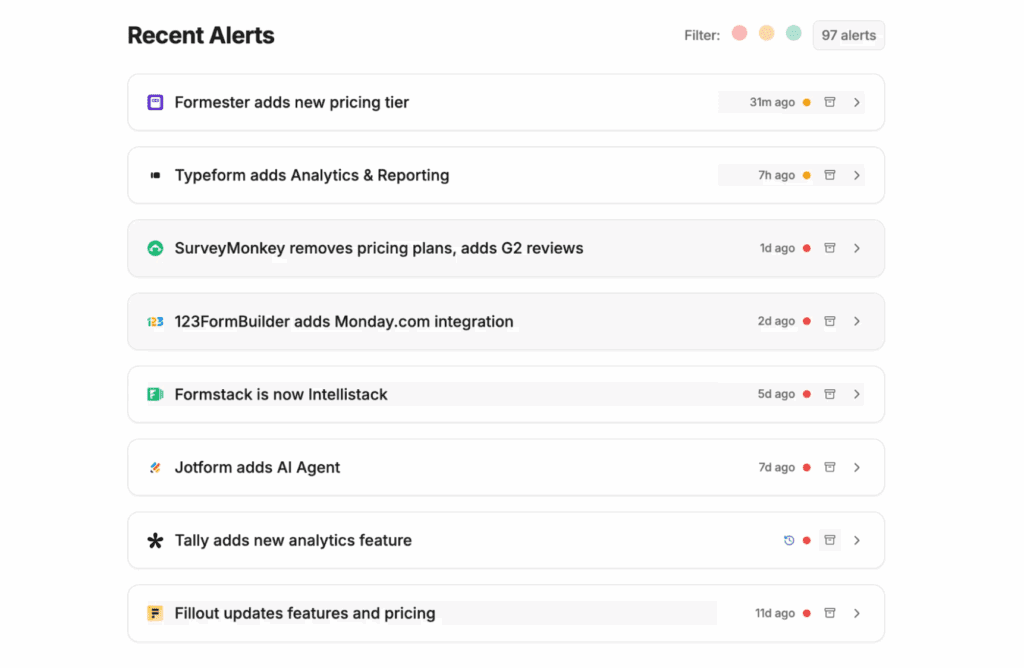
      HeadsUp is an AI-powered competitive intelligence platform that watches your market 24/7.

      It doesn’t just tell you what changed… It tells you what to do about it.

      🏆 #1 Product of the Day on Product Hunt

      Get 90 days of competitor intelligence in 60 seconds with HeadsUp:

      • See what you’ve been missing (pricing, features, positioning)
      • Know what to do about it, not just what happened
      • Get weekly briefs summarizing what matters

      See what you’ve been missing 👉 Try HeadsUp free


      The Most Popular Link From Last Week:
      🌙 Night Shift Agentic Workflow

      Get Weekly Reports

      Join 54,000+ founders and investors


        📈 Unlock Pro Reports, 1:1 Intros and Masterminds

        Become a Trends Pro Member and join 1,200+ founders enjoying…

        🧠 Founder Mastermind Groups • To share goals, progress and solve problems together, each group is made up of 6 members who meet for 1 hour each Monday.

        📖 160+ Trends Pro Reports • To make sense of new markets, ideas and business models, check out our research reports.

        💬 1:1 Founder Intros • Make new friends, share lessons and find ways to help each other. Keep life interesting by meeting new founders each week.

        💲 100k+ Startup Discounts • Get access to $100k+ in startup discounts on AWS, Twilio, Webflow, ClickUp and more.


        Brought to you by the team behind HeadsUp

        Outcome-Based Pricing: $0.99 Per Ticket, Who Owns The Billing Layer, The Mid-Market Trap

        “The best business model is the one where the customer only pays when they win.” – Patrick Campbell, ProfitWell

        Get Full Access to Trends Pro

        ❓ What You’ll Learn

        • Why are per-seat and flat pricing losing to paying for results?
        • Why are investors calling this the “SaaS massacre” for per-seat companies?
        • Which startups are racing to become the Stripe of outcome-based billing?
        • Why will mid-market SaaS companies get squeezed hardest by this shift?
        • How can you build a business helping SaaS companies switch pricing models?
        • Which vertical industries have zero dominant outcome-priced AI agents right now?
        • What risks should you plan for before switching your pricing model?
        • Who decides what counts as a “resolved” outcome and why should buyers worry?
        • Why is hybrid pricing the bridge and how fast are pure outcome models growing?
        • Why will the annual SaaS contract become obsolete?


        💎 Why It Matters

        Outcome-based pricing matches price with value.

        You pay for success instead of access.


        🔍 Problem

        Per-seat and flat-rate pricing have less aligned incentives.

        Charging per seat rewards inefficiency.

        Flat-rate hides margins.


        💡 Solution

        Charge for results instead of access to your product.

        Per resolved ticket, completed action or another successful outcome.


        🏁 Players

        Customer Support (Per-Resolution)

        • Intercom Fin • $0.99/resolution, $100M+ ARR, resolves 1M+ issues/week at 67%+ resolution rate.
        • Sierra AI • $150M ARR in 21 months, $10B valuation. Blends volume and per-resolution pricing.
        • Zendesk AI Agents • $1.50/resolution committed, $2.00 pay-as-you-go. Distribution across 100,000+ existing customers.

        Coding Agents (Per-Task / Per-Compute)

        • Devin (Cognition) • $2.25 per compute unit (~15 min of agent work). Slashed from $500-only to $20 entry tier.
        • Cosine Genie • Flat-rate pay-per-task. Counter-positioned against token-based billing.

        Enterprise Platforms (Per-Action / Credits)

        • Salesforce Agentforce • $0.10/action via Flex Credits. Processes 2B+ actions/mo.
        • GitHub Copilot • Hybrid $10-$39/mo plus $0.04/premium request. First major dev tool blending subscription with pay-per-use.

        Hybrid Subscription

        • Chargebee • Fixed platform fee with a variable fee based on total billing volume.

        Billing Infrastructure

        • Metronome • Acquired by Stripe for $1B (Dec 2025). Powers OpenAI and Databricks.
        • Orb • $44M raised. Revenue infrastructure for Perplexity, Pinecone, Vercel and Replit.
        • Stripe Billing • AI metering preview launched March 2026. Outcome-based billing as a checkbox.


        🔮 Predictions

        • Outcome-based pricing will become a standard clause in enterprise software contracts. Per-seat pricing will be limited to legacy renewals.
          • Chargebee projects 61% hybrid adoption by the end of 2026.
          • Atlassian reported its first-ever decline in enterprise seat counts.
          • Per-seat adoption already dropped from 21% to 15% in 12 months.
        • Vertical billing platforms will become the Stripe of outcome-based pricing. The race to own metering, invoicing and revenue recognition for per-outcome models is on.
          • Stripe paid $1B for Metronome when outcome-based pricing was still early.
          • Orb raised $44M. Open-source alternatives Flexprice and Lago are in land-grab mode.
          • Every SaaS company shifting models needs metering and revenue recognition tooling their current stack can’t handle.
        • Mid-market SaaS companies will get squeezed hardest. They lack the infrastructure for outcome pricing and the brand loyalty to hold per-seat rates.
          • Startups are born outcome-native with zero legacy billing to migrate.
          • Mid-market finance teams can’t model variable revenue on their current tools.
          • Enterprise vendors can afford dedicated pricing teams and multi-year contract buffers.


        ☁️ Opportunities

        • Launch a pricing migration consultancy for SaaS companies. Thousands of companies need to restructure pricing and can’t figure it out alone.
          • Gartner projects 40% outcome-based contracts by the end of 2026.
          • Simon-Kucher and McKinsey charge $200,000+ per engagement. Smaller companies need $5,000-$15,000 fixed-price packages.
          • 4 engagements/mo at $10,000 each is $480,000/year with zero funding. Revenue recognition (when you can count variable revenue as earned) is the sharpest pain point.
        • Ship an open-source billing engine built for outcome events. The mid-market needs Metronome capabilities at startup cost.
          • Lago and Flexprice are early open-source movers but haven’t locked up the mid-market yet.
          • Stripe acquired Metronome, validating the market. But Metronome serves enterprise customers.
          • 43% of companies already use hybrid billing. A purpose-built SDK with pre-built templates (“per resolution,” “per task,” “per hire”) is easier to adopt.
        • Own a vertical AI agent charging per outcome. Pick one industry, define one measurable outcome, price it below the human cost.
          • Specialized vertical agents show 3-5x higher retention than horizontal solutions.
          • The vertical AI market grew from $5.1B (2024) to $7.8B (2025), projected to hit $47B by 2030.
          • Sierra and Intercom own horizontal support. Verticals like recruiting, legal and bookkeeping are wide open.


        🏔️ Risks

        • Outcome Definition • Vendors decide what counts as “resolved.” Buyers have no independent way to verify or dispute results.
        • Buyer Cost Inflation • Better AI resolves more issues, which means higher bills. The buyer pays more as the product improves — the incentives work against each other.
        • Margin Squeeze • AI agents run at 50-60% gross margins vs. 80-90% for traditional SaaS. Many vendors cover the gap with venture capital.


        🔑 Key Lessons

        • Hybrid is the bridge. Pure outcome-based is the destination. 43% of companies already use hybrid models. Pure plays like Sierra and Intercom Fin are growing 5-10x faster.
        • Infrastructure is the safest bet. Every company shifting models needs metering, billing and revenue recognition tools they don’t have. The window closes when Stripe bundles it all.


        🔥 Hot Takes

        • The annual SaaS contract will become obsolete. Outcome-based pricing is variable by nature. Real-time metering makes annual commitments unnecessary and poorly aligned for both sides.
        • Per-seat pricing survives only where AI adoption is slowest. Government, heavily regulated industries and unionized workforces will be the last holdouts. Everyone else transitions by 2028.


        😠 Haters

        “This only works for categories with clear outcomes. Such as support tickets and code completions.”
        “Per action” and “per task” pricing are bridging the gap for less binary outcomes. The categories without a clean billable unit will be last to switch.

        “Half these ‘resolutions’ aren’t real. The AI links a help article, the customer gives up and 72 hours later it’s marked resolved.”
        Expect buyers to demand third-party audits of resolution quality. Complexity-weighted pricing may replace flat per-resolution rates.

        “You can’t reliably prove your product drove the outcome. Was it the AI or the customer figuring it out on their own?”
        Outcome-based pricing works best where the AI is the only thing in the loop. The market will split: autonomous agents will price per outcome, copilots with human-in-the-loop will price per usage.

        “64% of finance executives say revenue unpredictability is their top concern with this model. You’re asking CFOs to trade a fixed budget for a guessing game.”
        Outcome-based spend swings with volume, seasonality and AI performance. A spike in support tickets means a spike in your AI bill. That’s why hybrid models (base fee + outcome variable) are winning. Pure outcome-based is the destination, but CFOs need a floor they can forecast against.

        “Every outcome-priced vendor sits on top of foundation model APIs they don’t control. One price hike from OpenAI and the unit economics break overnight.”
        Model costs have dropped 10x+ in 18 months and competition between OpenAI, Anthropic, Google and open-source keeps pushing prices down. Smart vendors hedge across multiple providers and lock in pricing tiers.

        “Enterprise buyers will demand outcome pricing AND annual volume discounts. You’ll end up with the worst of both models.”
        Large buyers already want the upside of outcome pricing (pay only for results) plus the benefit of annual commitments (volume discounts and budget predictability). Vendors who aren’t careful will end up with capped upside and committed minimums that look like per-seat contracts with extra billing complexity.


        🔗 Links

        1. The SaaS Massacre • The definitive analysis of per-seat collapse and Service-as-Software.
        2. How Intercom Built Outcome-Based Pricing • Inside the strategy behind $0.99/resolution and Fin’s growth.
        3. Rethinking B2B Software Pricing in the Agentic AI Era • How AI agents are forcing enterprise software to reprice around outcomes and actions.


        📈 Want the full picture?

        What is “outcome washing” and why will it trigger the next buyer backlash?

        Why will the first outcome-based company to IPO rewrite how Wall Street values software?

        Why will gross margins compress to 50-60% and stay there as investors build new valuation frameworks?

        How do you build an outcome verification layer that charges 1-2% of every AI vendor’s billings?

        Why will outcome-based pricing kill the annual contract?

        What is the market rate for a resolved ticket, a screened candidate, or a drafted contract?

        Why will Fortune 50 companies skip vendors and buy raw API credits directly from model providers?

        Why do 78% of IT leaders report unexpected charges from AI pricing?

        Why have only 9% of companies fully shipped outcome pricing despite 47% piloting?

        Why does vertical beat horizontal for founders building outcome-priced AI agents?

        Trends Pro has the answers. Plus 22 players, 7 predictions, 11 opportunities and 12 links.

        Get Weekly Reports

        Join 54,000+ founders and investors


          📈 Unlock Pro Reports, 1:1 Intros and Masterminds

          Become a Trends Pro Member and join 1,200+ founders enjoying…

          🧠 Founder Mastermind Groups • To share goals, progress and solve problems together, each group is made up of 6 members who meet for 1 hour each Monday.

          📖 160+ Trends Pro Reports • To make sense of new markets, ideas and business models, check out our research reports.

          💬 1:1 Founder Intros • Make new friends, share lessons and find ways to help each other. Keep life interesting by meeting new founders each week.

          💲 100k+ Startup Discounts • Get access to $100k+ in startup discounts on AWS, Twilio, Webflow, ClickUp and more.


          Brought to you by the team behind HeadsUp
          📎 Can a Team of AI Agents Run a Business?


          This week’s Founder Finds includes:

          💡 How to build agency
          🌙 The night shift workflow
          📎 An AI agent orchestrator
          ⚡ The power of being responsive
          🔍 A generative engine optimization tool
          ➡️ And more…


          🪶 Remember This

          The market doesn’t have to understand you. Clarity is your job.


          🤓 Fav Finds

          Tools, tweets and more from Trends Pro Members


          📎 Paperclip shared by Elie Steinbock 
          An agent orchestrator that manages a team to run a business


          🌙 Night Shift Workflow shared by Gabriel
          An agentic workflow where agents take the night shift


          🔍 GEO-SEO-Claude shared by Hitesh & Jason A Erickson
          A tool to optimize websites for AI-powered search engines


          🏆 Trends Pro Member Wins

          🍀 Dru Riley published “How to Get Lucky in Life”, on luck as a design problem


          ⌨️ Elie Steinbock made a list of cool open source projects


          🎞️ Dru Riley added YouTube auto-publishing to Multi


          📅 Maciej Cupial shipped an AI assistant for Calendesk


          🛠️ Knight built 3 product prototypes


          📘 Read This

          Why Will Getting Rejected Make You Stronger?

          Getting rejected from things that matter is how you find out where your real limits are.

          Do things others avoid:

          • Test your limits. Apply for jobs you think you won’t get. Send emails that make you cringe.
          • Meet people without an obvious reason. Great collaborations often come from random coffee chats.
          • Get comfortable being bad at things. Ask dumb questions and look stupid. It’s the only way to level up.


          🛠️ Tools of the Week

          🧿 HeadsUp.bot — Stay ahead of competitors

          🎞️ Multi — Grow on YouTube on autopilot

          📱 Rork — Build mobile apps with AI


          🔧 Try This

          How Can You Beat Competitors by Simply Being Responsive?

          Responding 48 hours later kills trust. The customer has no idea if you’re working on their problem or ignoring them.

          Here’s what you should do:

          • Add a specific timeline. “I’ll be back in touch by X” sets clear expectations.
          • Recognize the urgency. Going silent on an urgent request amplifies stress.
          • Send back a message immediately. “I’m looking into it” changes the experience from uncertainty to knowing someone’s on it.


          🔧 Try This

          60 Seconds to Your First Competitive Insight

          HeadsUp is an AI-powered competitive intelligence platform that watches your market 24/7.

          It doesn’t just tell you what changed… It tells you what to do about it.

          🏆 #1 Product of the Day on Product Hunt

          Get 90 days of competitor intelligence in 60 seconds with HeadsUp:

          • See what you’ve been missing (pricing, features, positioning)
          • Know what to do about it, not just what happened
          • Get weekly briefs summarizing what matters

          See what you’ve been missing 👉 Try HeadsUp free


          The Most Popular Link From Last Week:
          📒 The Claude Playbook

          Get Weekly Reports

          Join 54,000+ founders and investors


            📈 Unlock Pro Reports, 1:1 Intros and Masterminds

            Become a Trends Pro Member and join 1,200+ founders enjoying…

            🧠 Founder Mastermind Groups • To share goals, progress and solve problems together, each group is made up of 6 members who meet for 1 hour each Monday.

            📖 160+ Trends Pro Reports • To make sense of new markets, ideas and business models, check out our research reports.

            💬 1:1 Founder Intros • Make new friends, share lessons and find ways to help each other. Keep life interesting by meeting new founders each week.

            💲 100k+ Startup Discounts • Get access to $100k+ in startup discounts on AWS, Twilio, Webflow, ClickUp and more.


            Brought to you by the team behind HeadsUp

            🧩 Can AI Agents Replace An Entire Agency Team?


            This week’s Founder Finds includes:

            🧩 An AI agency
            📒 The Claude playbook
            💳 When to send a refund?
            💀 25 hard truths about solo founders
            🐙 Google’s autonomous coding agent
            ➡️ And more…


            🪶 Remember This

            The best time to make hard decisions is before they become urgent.


            🤓 Fav Finds

            Tools, tweets and more from Trends Pro Members


            📒 The Claude Playbook shared by Elie Steinbock
            A guide for business operators for mastering Claude


            🧩 The Agency shared byHitesh Kar
            A collection of AI agent specialists forming a full digital agency


            🐙 Jules shared byRich Tank
            A coding agent from Google that works autonomously


            🏆 Trends Pro Member Wins

            🧿 Dru Riley published “The Four Games of Life”, on the cost of treating sales like code


            👥 Jason A Erickson built GetRallied


            🎨 Elie Steinbock made a video about Paper.design


            🎬 Yuyu is building a curated movie directory


            📘 Read This

            Why Do So Many Startups Die Because Of Co-Founders?

            The distance between “I have an idea” and “someone paid me” can be shorter than you think.

            Here’s what works for solo founders:

            • Run the service manually before building software. Learn edge cases, then productize.
            • Start with contractors. Browserbase was built this way and a year later it’s a Series B company.
            • Recognize when co-founder searching is avoidance. If you’ve been looking for 3 months, ask what you’d be doing if you went alone.


            🛠️ Tools of the Week

            🧿 HeadsUp.bot — Stay ahead of competitors

            🎞️ ​Gling.ai​ — Let AI edit your videos

            🖼️ Aragon AI — Use AI to do a photo shoot

            🎙️ Podsqueeze — Automate podcast content creation


            🔧 Try This

            When Should You Just Give Them Their Money Back?

            “Every time I’ve fought a customer over a refund instead of processing it, I’ve regretted it. The math is brutal.”

            Here’s why you should just refund them:

            • Disputes consume hours of arguing and that time is worth more than the refund.
            • Don’t refund more than they paid and if they want a full refund, stop working together.
            • Fighting creates an angry customer who’ll talk about how bad you are. Reputation costs more than the refund.


            🔧 Try This

            60 Seconds to Your First Competitive Insight

            HeadsUp is an AI-powered competitive intelligence platform that watches your market 24/7.

            It doesn’t just tell you what changed… It tells you what to do about it.

            🏆 #1 Product of the Day on Product Hunt

            Get 90 days of competitor intelligence in 60 seconds with HeadsUp:

            • See what you’ve been missing (pricing, features, positioning)
            • Know what to do about it, not just what happened
            • Get weekly briefs summarizing what matters

            See what you’ve been missing 👉 Try HeadsUp free


            The Most Popular Link From Last Week:
            🧰 Claude Cowork Plugins

            Get Weekly Reports

            Join 54,000+ founders and investors


              📈 Unlock Pro Reports, 1:1 Intros and Masterminds

              Become a Trends Pro Member and join 1,200+ founders enjoying…

              🧠 Founder Mastermind Groups • To share goals, progress and solve problems together, each group is made up of 6 members who meet for 1 hour each Monday.

              📖 160+ Trends Pro Reports • To make sense of new markets, ideas and business models, check out our research reports.

              💬 1:1 Founder Intros • Make new friends, share lessons and find ways to help each other. Keep life interesting by meeting new founders each week.

              💲 100k+ Startup Discounts • Get access to $100k+ in startup discounts on AWS, Twilio, Webflow, ClickUp and more.


              Brought to you by the team behind HeadsUp

              Prediction Markets: Polls vs Predictions, AI Agents Trading, Accuracy Gap

              “Don’t tell me what you think. Tell me what you have in your portfolio.” – Nassim Nicholas Taleb

              Get Full Access to Trends Pro

              ❓ What You’ll Learn

              • Why does putting money on a prediction make it more accurate?
              • Why did prediction markets grow 400% in 1 year?
              • How did Polymarket call the 2024 US election at 95% before major TV networks did?
              • What regulatory window exists for founders entering prediction markets now?
              • What opportunities exist in prediction market data, vertical applications and analytics infrastructure?
              • What happens when AI agents start trading on prediction markets?
              • Why can a data API be worth more than the entire exchange?


              💎 Why It Matters

              When money is on the line, forecasts beat experts and polls at predicting events.


              🔍 Problem

              Forecasting without financial consequences rewards confidence over accuracy.


              💡 Solution

              Prediction markets make people bet money on what they believe will happen.

              Wrong bets lose money. The result is a real-time probability signal.


              🏁 Players

              Prediction Platforms

              • Polymarket • Crypto-native prediction market on Polygon/USDC. Relaunched for U.S. users in January 2026.
              • Kalshi • First CFTC-designated prediction market exchange.
              • Metaculus • Community forecasting platform for science, tech and geopolitics. Runs INFER program for U.S. government.
              • Good Judgment • Philip Tetlock’s superforecaster enterprise service for corporate and government clients.

              Mainstream Finance Platforms

              • Robinhood • Major retail brokerage embedding event contracts into its existing trading app.
              • CME Group • Futures exchange offering event contracts and partnering with FanDuel for consumer sports contracts.
              • DraftKings • Sports betting platform that launched “DraftKings Predictions” in 38 states after acquiring Railbird.

              Crypto/DeFi Protocols

              • Azuro • Sports-focused DeFi prediction protocol building a liquidity layer for on-chain betting.
              • Limitless • Prediction market on Base (Coinbase L2).

              Infrastructure & Data

              • ICE • Exclusive institutional data provider for Polymarket odds through its “Polymarket Signals & Sentiment” product.
              • Cultivate Labs • Enterprise prediction market platform serving U.S. government, Canadian Forest Service and UK government clients.


              🔮 Predictions

              • AI agents will play in prediction markets, improving liquidity and accuracy. The algorithmic trading playbook repeats.
                • Presagio helps AI agents join prediction markets.
                • Dome is building the API infrastructure that makes programmatic trading accessible.
              • At least one prediction market platform will IPO. The financials support it.
                • Kalshi had $260M in 2025 revenue growing at 994% YoY.
                • ICE (NYSE parent, $75B+ market cap) invested $2B in Polymarket.
                • Kalshi and Polymarket are seeking $20B valuations as of March 2026.
              • Traditional polling firms will adopt prediction market signals or lose credibility. The accuracy gap is too wide to ignore.
                • Combined forecasts (polls + markets + models) reduce error by 16-59% vs. any single method.
                • Iowa Electronic Markets outperformed 74% of polls across five presidential elections (1988-2004).
                • Polymarket called the 2024 US election at 95% probability before midnight while networks hadn’t called key states.


              ☁️ Opportunities

              • Build the “Bloomberg Terminal” for prediction market data. Offer a cross-platform probability API.
                • ICE holds exclusive rights to map Polymarket odds to institutional securities data.
                • Normalize prices across Polymarket, Kalshi, PredictIt and DeFi protocols into a single API. Bloomberg terminals cost $24,000/year because they aggregate financial data.
              • Launch vertical prediction markets for specific industries. Horizontal platforms leave domain-specific forecasting underserved.
                • Cultivate Labs proves the enterprise model works with government clients.
                • Start with non-financial event contracts that don’t trigger securities regulation.
                • Target real estate closing dates, clinical trial outcomes, supply chain disruption and crop yields.
              • Ship AI-powered market making infrastructure. Thin liquidity is a major constraint on non-headline events.
                • Dome offers live trades and deep historical data via a simple API/SDK.
                • The analogy is Citadel Securities or Virtu for prediction markets but accessible to smaller operators.
                • Revenue comes from the bid-ask spread. AI bots ingest news, social data and domain feeds to provide continuous quotes.
              • Own the analytics layer. Build TradingView for prediction markets. 600,000+ monthly active users need tools to see cross-market correlations.
                • Many active prediction market traders already pay for analytics in equities and crypto.
                • Overlay news events, sentiment data and historical accuracy. Monetize through subscriptions.


              🏔️ Risks

              • Gambling Framing • If regulators classify prediction markets as gambling, platforms face state-level regulation, gambling tax treatment and social stigma. 44% of projected long-run volume is sports.
              • Manipulation • A French trader moved Polymarket’s 2024 election odds with concentrated bets. Thin markets with large positions are vulnerable to price distortion.
              • Accuracy Overfitting • Most accuracy evidence comes from the 2024 U.S. election. One data point across one event type is not a track record.


              🔑 Key Lessons

              • Skin in the game is the mechanism. Prediction markets work because traders who are wrong lose money. Any forecasting system that doesn’t penalize inaccuracy gets captured by groupthink, career incentives or ideology. The difference between a poll and a market is financial consequence.
              • Regulatory timing creates the window. The CFTC posture flipped from prohibition to active framework-building. Companies that launch now shape the rules. Companies that wait operate within rules they didn’t influence.
              • The real product is the probability signal. The companies that capture the most value may not be the exchanges themselves but the companies that package, distribute and build on top of prediction market data. The data API opportunity could be larger than the platform opportunity.


              🔥 Hot Takes

              • Prediction markets will replace polling as the primary election forecast. The 2024 election proved it. Polymarket was right. The polls were wrong. Media outlets are already citing market prices as probability signals. By 2028, the question won’t be “what do the polls say?” but “what does the market say?”
              • Standalone prediction market platforms are dead. The future is embedded. Robinhood, Cboe, CME, Nasdaq. Every major financial platform is embedding event contracts. Visiting a separate prediction market website will feel like visiting a separate stock trading website. The category gets absorbed.
              • The Maduro trade was the market working. Someone had information. They expressed it with money. The price moved. The market reflected reality before institutions did. That’s exactly what prediction markets are supposed to do. The uncomfortable part is that it also proves the insider trading problem is real.


              😠 Haters

              “Prediction markets are just gambling with better branding.”
              The functional mechanics are identical to sports betting. But prediction markets produce socially useful price signals.

              “The real product is the dopamine hit, not the price signal.”
              Fair. Look at what gets volume: elections, celebrity drama, sports. Not crop yields or supply chain disruptions. The architecture supports serious forecasting. The users want entertainment.

              “This is regulatory arbitrage.”
              Every financial innovation starts in a regulatory gap. ETFs, credit default swaps, crypto. The question is whether the product survives when the gap closes.

              “The insider trading problem is real and unsolved.”
              Stock markets have had the same problem since 1929 and still haven’t solved it. They just built enforcement over 90 years. Prediction markets are 2 years old at scale. The government is writing rules. Give them time.


              🔗 Links

              1. The Accuracy Paradox: Vanderbilt Study on Prediction Market Reliability • The most comprehensive post-mortem of 2024 election prediction markets. PredictIt hit 93% accuracy while Polymarket lagged at 67%. Betting caps may matter more than volume.
              2. Prediction Markets May Be Getting a Rule Book • March 2026 analysis of the CFTC’s advanced notice of rulemaking. The regulatory picture in real time.
              3. How Prediction Markets Work • Accessible explainer for mainstream audiences. Good primer for anyone new to the space.


              📈 Want the full picture?

              How did one anonymous trader turn $30,000 into $436,759 on Polymarket days before Maduro’s capture?

              Why did the Federal Reserve call Kalshi’s forecast record “perfect” and what does that mean for institutional adoption?

              Who is defending its right to offer sports contracts in 50+ lawsuits?

              Why does distribution beat product in prediction markets?

              Why are 12+ U.S. states challenging prediction market operators?

              How big is the enterprise opportunity in a world where corporate forecasts are still 20–50% inaccurate?

              What should you know about the prediction market integrity problem?

              When will the “gambling” framing on prediction markets collapse?

              Why are India, Brazil and Europe the largest untapped prediction market opportunities?

              Trends Pro has the answers. Plus 25 players, 7 predictions, 11 opportunities and 11 links.

              Get Weekly Reports

              Join 54,000+ founders and investors


                📈 Unlock Pro Reports, 1:1 Intros and Masterminds

                Become a Trends Pro Member and join 1,200+ founders enjoying…

                🧠 Founder Mastermind Groups • To share goals, progress and solve problems together, each group is made up of 6 members who meet for 1 hour each Monday.

                📖 160+ Trends Pro Reports • To make sense of new markets, ideas and business models, check out our research reports.

                💬 1:1 Founder Intros • Make new friends, share lessons and find ways to help each other. Keep life interesting by meeting new founders each week.

                💲 100k+ Startup Discounts • Get access to $100k+ in startup discounts on AWS, Twilio, Webflow, ClickUp and more.


                Brought to you by the team behind HeadsUp

                Micro-App Portfolios: 5% Hit Rate, Vibe-Coded Exits, Portfolio OS

                “The way to get good ideas is to get lots of ideas and throw the bad ones away.” – Linus Pauling

                Get Full Access to Trends Pro

                ❓ What You’ll Learn

                • Who launched 70+ projects with zero employees and reached $3.1M ARR?
                • How do vibe coding tools make the portfolio model viable?
                • What does practical portfolio math look like?
                • What tools are still missing for operators managing 10-40+ apps?
                • What is a portfolio OS category?
                • Why could portfolio founders outperform single-product founders?
                • Why do high failure rates push founders toward portfolio thinking?
                • Is 5% hit rate of a portfolio a signal of success?
                • Which $20-$50/app/mo service model turns the portfolio’s liability into a recurring revenue stream?


                💎 Why It Matters

                Solo founders are treating startup creation like a portfolio.

                Ship fast, kill fast and find a few winners that cover the failures.


                🔍 Problem

                Putting everything into one product creates concentration risk.

                Solo founders often need a long time to make steady money. This makes one-product bets fragile.


                💡 Solution

                Build many small products instead of one all-in bet.

                Lower variance, double down on traction and retire weak apps early.


                🏁 Players

                Portfolio Operators

                • Pieter Levels • 70+ projects, 4 made money (~5% hit rate). $3.1M ARR, zero employees. PhotoAI ($132,000/mo), RemoteOK ($41,000/mo), InteriorAI ($38,000/mo). Runs everything on vanilla PHP, jQuery, SQLite and a simple VPS
                • Danny Postma • HeadshotPro made $300,000 in the 1st year. The portfolio includes TattoosAI, StockAI, ProfilePictureAI, Deep Agency.
                • Marc Lou • 23 projects before finding his hit. $1.03M earned in 2025. ShipFast + CodeFast (~$20,000/mo each), DataFast ($15,800 MRR, growing 14% MoM), TrustMRR (built in 24 hours, now a verified startup marketplace with 120,000 visitors/mo and ~1 acquisition/day; turned down an acquisition offer)
                • Tony Dinh • Vietnamese dev who quit corporate after 7 years. TypingMind ($130,000-$160,000/mo), DevUtils ($5,000/mo). ~$142,000/mo total. Sold BlackMagic.so for $128,000 after Twitter API pricing killed margins
                • Erikas Malisauskas • $4.5M/year from a Shopify app portfolio. $100,000 marketing spend, ~90% margins. 5+ apps including Kaching Bundles and Kaching Post Purchase Upsell

                Build Tooling

                • Cursor • AI-powered code editor with 1M+ daily active users, $1B+ ARR, $29.3B valuation. 50%+ of Fortune 500 using it.
                • Lovable • AI app builder that hit $100M ARR in 8 months (fastest ever). 10M+ projects built, 100,000/day. Raised $330M at $6.6B valuation.
                • Bolt.new • Prompt-to-fullstack app builder. $40M ARR in 6 months, 5M signups.
                • ShipFast • Next.js boilerplate, the category leader. Users launch in an average of 7 days. 7,200+ developers, $199 one-time. $130,000+/mo revenue.

                Acquisition Marketplaces

                • Acquire.com • The dominant marketplace for SaaS acquisitions ($50,000-$5M+)
                • Flippa • Broadest marketplace: SaaS, content sites, ecommerce, apps
                • Empire Flippers • Curated/vetted businesses at $100,000-$10M+

                Portfolio Analytics and Billing

                • ChartMogul • Subscription analytics supporting multiple billing systems and products in one view. Benchmarks against 2,500+ SaaS companies.
                • Paddle • Merchant of record handling tax, payments and analytics globally. 5% + $0.50/tx. Run multiple products under one billing entity.


                🔮 Predictions

                • Portfolio founders will outearn single-product founders. The math favors portfolios at the median, not the top. As vibe coding tools push build time toward zero, the cost of adding another app drops below the cost of iterating on a failing one.
                  • Pieter Levels‘ hit rate is 5%, but his portfolio generates $3.1M ARR.
                  • The strategy works for the same reason index funds beat stock picking for most investors.
                  • If AI tools plateau and micro-apps require as much maintenance as full SaaS, the advantage erodes.
                • We’ll see a “portfolio OS”. Portfolio operators are stitching together Stripe dashboards, separate analytics accounts and spreadsheets. There’s no unified tool for managing 10+ apps.
                  • Portfolio operators are already building one-off internal tools to solve pieces of the problem.
                  • If Stripe, Vercel or Railway add portfolio features as built-in capabilities, the standalone market shrinks.
                  • For now, this white space needs consolidated revenue tracking, shared auth, cross-app analytics, unified support.
                • Vibe coding will produce a wave of undifferentiated apps, triggering a distribution crisis. When build cost goes to zero, supply floods. Lovable alone has produced 10M+ projects. Discovery becomes the bottleneck, not creation.
                  • Portfolio operators with existing audiences (Pieter Levels’ 800,000+ Twitter following, Marc Lou’s newsletter) will have a structural advantage.
                  • The pattern mirrors what happened to mobile apps in 2012-2014: the App Store went from curated to flooded and distribution became the moat.
                  • Improved app store algorithms and AI-powered discovery tools will help the supply glut self-sort faster than expected.


                ☁️ Opportunities

                • Ship a portfolio operating system that gives founders a single view across all their products: combined MRR, churn by app, shared customer database, cross-app analytics and consolidated support inbox.
                  • Start with a dashboard that connects to Stripe, Plausible/PostHog and your hosting provider.
                  • Each operator has built one-off internal tools to solve pieces of this problem. When practitioners build their own tools, the productized version is overdue.
                  • Charge $49-$199/mo based on the number of connected apps. Small customer base but high-value.
                • Offer distribution-as-a-service for micro-apps. As vibe coding floods the market, discovery becomes the bottleneck. Most portfolio founders rely on their personal audience for distribution. Founders without an audience have great products nobody sees. Max Huang credits ASO optimization as the key lever that boosted his portfolio metrics by 50%.
                  • Price at 10-15% of revenue driven or a flat monthly retainer.
                  • Handle ASO, Product Hunt launches, social media promotion, content marketing, influencer seeding for a portfolio of micro-apps.
                • Launch an AI-powered app maintenance service. The hidden tax of the portfolio model is maintenance: dependency updates, security patches, uptime monitoring, bug fixes across 10-30 apps. Most portfolio founders do this manually or defer it until something breaks.
                  • Price at $20-$50/app/mo. A founder with 15 apps pays $300-$750/mo for peace of mind.
                  • The value proposition: turn your portfolio from a maintenance burden into a passive income stream.
                  • The AI tooling to build this exists today (Claude Code, GitHub Copilot, Dependabot). The integration layer is the product.


                🏔️ Risks

                • Revenue Concentration • Portfolios can still depend on 1 or 2 winners carrying the losses from other bets.
                • Strategy Drift • Jon Yongfook says multi-project momentum requires resets when focus gets diluted.
                • Channel Dependency • Portfolio diversification does not remove channel risk if growth relies on one lever (for example SEO/ASO).


                🔑 Key Lessons

                • The hit rate is 5%. The strategy is volume. Pieter Levels launched 70+ projects and 4 made money. Marc Lou shipped 23 before ShipFast became his breakout. You don’t need to predict which app will win. You need to make enough bets that the math works in your favor.
                • Distribution is the moat, not code. Lovable has built 10M+ projects. The ability to build is no longer a scarce resource. You need an audience that will try what you build.


                🔥 Hot Takes

                • The “12 startups in 12 months” challenge will become the default onboarding path for new founders, replacing accelerators and MBA programs as the most effective way to learn startup fundamentals. You learn more while shipping 12 things than writing one business plan.
                • The most valuable company in the micro-app space will be the portfolio OS that every operator runs on. The picks-and-shovels play wins in a gold rush.


                😠 Haters

                “Many of these ‘micro’ apps aren’t micro. Nomad List and HeadshotPro are real businesses.”
                Fair. PhotoAI makes $132,000/mo. HeadshotPro made $300,000 in the 1st year. These aren’t weekend side projects. But the “micro” refers to the initial bet size, not the ceiling. Levels didn’t plan for PhotoAI to be his biggest product. He built 70+ things and let the market pick the winner. Most apps in a portfolio start micro and some grow into full businesses.

                “You’re building a graveyard of half-finished products, not a portfolio.”
                The maintenance burden is real. At 10+ apps, the operational overhead can overwhelm a solo founder. Most founders who attempt the portfolio model will underestimate the compounding cost of keeping many products alive. The 5% hit rate means 95% of your portfolio is dead weight that still needs periodic attention.

                “Survivorship bias is doing all the heavy lifting here.”
                We hear about Pieter Levels and Danny Postma because they succeeded publicly. The Indie Hackers graveyard is full of founders who shipped 10 apps, none of which found traction and burned out. The 92% SaaS failure rate doesn’t improve with volume if the fundamental issue is distribution, not product.

                “Vibe-coded apps are a race to the bottom. Zero moat, zero defensibility.”
                If you can build it in 24 hours, so can your competitor. When build cost goes to zero, the only remaining moats are distribution, brand and data. The winners will be founders who pair speed-to-ship with genuine distribution advantages, not founders who ship the most.

                “The portfolio model is really a lifestyle business ceiling dressed up as a strategy.”
                Solo founders running portfolios often cap out at $3M-$5M ARR because there’s no organizational leverage. You can’t hire without changing the economics. You can’t raise without changing the model. The portfolio model is great for earning $500,000-$3M per year, but that ceiling is real. For founders who want venture-scale impact, the portfolio model is a detour.

                “Platform risk doesn’t disappear with diversification: it multiplies.”
                A portfolio spread across Apple, Google, Stripe and various hosting providers means you’re exposed to each platform’s terms of service changes. A Stripe policy change could freeze payments for your entire portfolio. Diversification across products doesn’t equal diversification across platforms. The correlation risk is higher than it appears.


                🔗 Links

                1. Here’s How These Founders Are Building Multiple Products at Once • A candid look at what breaks first when you run multiple products: focus, systems, or stamina.
                2. How I Manage Running Multiple Products of $18,000/mo Total Revenue • A practical operating snapshot of what “portfolio mode” looks like day to day when one person is juggling everything.
                3. How I Launched and Maintain Multiple Products at the Same Time • A first-person account of juggling build cycles, maintenance, and motivation across products in parallel.


                📈 Want the full picture?

                Who rebuilt a $60,000/mo app portfolio after losing $34,000/mo overnight to a single platform ban?

                How does a 23-year-old run a mobile app portfolio generating $185,000/mo with no venture backing?

                Is there a cap to the solo portfolio model at 90%+ margins?

                Why are boilerplates at $130,000+/mo today actually a dead category walking?

                How do you build a portfolio CFO service where founders running 10-30 revenue streams across multiple Stripe accounts will pay premium rates?

                Why will the first solo founder to cross $10M ARR trigger a wave of $300,000-$500,000 big tech exits?

                Trends Pro has the answers. Plus 14 players, 7 predictions, 8 opportunities and 13 links.

                Get Weekly Reports

                Join 54,000+ founders and investors


                  📈 Unlock Pro Reports, 1:1 Intros and Masterminds

                  Become a Trends Pro Member and join 1,200+ founders enjoying…

                  🧠 Founder Mastermind Groups • To share goals, progress and solve problems together, each group is made up of 6 members who meet for 1 hour each Monday.

                  📖 160+ Trends Pro Reports • To make sense of new markets, ideas and business models, check out our research reports.

                  💬 1:1 Founder Intros • Make new friends, share lessons and find ways to help each other. Keep life interesting by meeting new founders each week.

                  💲 100k+ Startup Discounts • Get access to $100k+ in startup discounts on AWS, Twilio, Webflow, ClickUp and more.


                  Brought to you by the team behind HeadsUp

                  🔗 Can AI Agents Run Your Entire Google Workspace?


                  This week’s Founder Finds includes:

                  🔗 Google Workspace CLI
                  🧰 Claude Cowork Plugins
                  💡 The power of obvious ideas
                  🎯 Automating Meta ads with AI
                  🗺️ A roadmap to product/market fit
                  ➡️ And more…


                  🪶 Remember This

                  Every loss is a lesson in disguise.


                  🤓 Fav Finds

                  Tools, tweets and more from Trends Pro Members


                  🎯 Automated Ad Machine with Claude Code shared by Kieran Ball
                  A guide to Meta ad generation and management with coding agents


                  🧰Claude Cowork Plugins shared by Denis S
                  Bundles of skills, connectors, commands and sub-agents for specific roles


                  🔗Google Workspace CLI shared byHitesh Kar
                  A tool that gives agents direct access to Google Workspace apps


                  🏆 Trends Pro Member Wins

                  🧿 Dru Riley published “Fuck Around to Find Out”, on the cost of skipping the messy part


                  🧠Yuriy built anagent memory system


                  🥗Maciej Cupial posted aguide to healthy eating


                  ⚙️ Prabhjot Singh Lamba built an AI text embedding visualizer


                  🎨 Wojtek Wozniak launched a wireframe builder


                  📘 Read This

                  Why Do Your “Obvious” Ideas Seem Like Genius to Someone Else?

                  Your “obvious” work might feel brilliant to someone else.

                  • Realize you’re a bad judge: hit songwriters often admit their most successful songs were ones they thought were stupid and not worth recording
                  • Stop holding back: that thing you think is too obvious can be exactly what someone else desperately needs
                  • Put your work out there: share your ideas and let the world decide their value


                  🛠️ Tools of the Week

                  🧿 HeadsUp.bot — Stay ahead of competitors

                  🎞️ ​Gling.ai​ — Let AI edit your videos

                  🖼️ Aragon AI — Use AI to do a photo shoot

                  🎙️ Podsqueeze — Automate podcast content creation


                  🔧 Try This

                  What’s Your Roadmap to Product/Market Fit?

                  Here’s an 8-step process to finding a product-market fit:

                  • Market Fit: Most good ideas aren’t good businesses
                  • Personal Fit: Passion is not enough. Winning requires a personal edge.
                  • Customer Fit: Talk to customers before wasting months building the wrong thing.


                  🔧 Try This

                  60 Seconds to Your First Competitive Insight

                  HeadsUp is an AI-powered competitive intelligence platform that watches your market 24/7.

                  It doesn’t just tell you what changed… It tells you what to do about it.

                  🏆 #1 Product of the Day on Product Hunt

                  Get 90 days of competitor intelligence in 60 seconds with HeadsUp:

                  • See what you’ve been missing (pricing, features, positioning)
                  • Know what to do about it, not just what happened
                  • Get weekly briefs summarizing what matters

                  See what you’ve been missing 👉 Try HeadsUp free


                  👋 New Trends Pro Members

                  • Justin Setzer
                  • Arshad Teli
                  • Rodolfo Ruiz


                  The Most Popular Link From Last Week:
                  🚀 AI Agent Marketing Skills

                  Get Weekly Reports

                  Join 54,000+ founders and investors


                    📈 Unlock Pro Reports, 1:1 Intros and Masterminds

                    Become a Trends Pro Member and join 1,200+ founders enjoying…

                    🧠 Founder Mastermind Groups • To share goals, progress and solve problems together, each group is made up of 6 members who meet for 1 hour each Monday.

                    📖 160+ Trends Pro Reports • To make sense of new markets, ideas and business models, check out our research reports.

                    💬 1:1 Founder Intros • Make new friends, share lessons and find ways to help each other. Keep life interesting by meeting new founders each week.

                    💲 100k+ Startup Discounts • Get access to $100k+ in startup discounts on AWS, Twilio, Webflow, ClickUp and more.


                    Brought to you by the team behind HeadsUp

                    Agentic Payments: Autonomous Transactions, Identity Credentials, Fraud Control Gap

                    “402 Payment Required — Reserved for future use.” – HTTP/1.1 Specification, 1997

                    Get Full Access to Trends Pro

                    ❓ What You’ll Learn

                    • Why do AI agents need payment rails built for software, not humans?
                    • Where the biggest near-term opportunities and risks are in agentic payments?
                    • What “Know Your Agent” (KYA) means and why trust/compliance is a key bottleneck?
                    • Which core payment protocols are shaping agent commerce and what role each plays?
                    • Why did HTTP 402 (“Payment Required”) wait since 1997to power machine-to-machine transactions?


                    💎 Why It Matters

                    Payment infrastructure is designed for humans.

                    Agent-native payments unlocks the entire autonomous economy.


                    🔍 Problem

                    Payment infrastructure is built for humans.

                    Agents transact continuously, in milliseconds, at volumes no human can match.

                    Current rails aren’t designed for that.


                    💡 Solution

                    Agentic payments are money tools made for AI agents.

                    They help AI agents prove identity, move money and follow spending limits.


                    🏁 Players

                    Institutional Rails

                    Crypto-Native Rails

                    • Coinbase (x402) • Open payment rail for stablecoin transactions between agents and online services.
                    • Solana • Blockchain settlement layer used for fast, low-cost agent micropayments.

                    Agent-Specific Payment Infrastructure

                    • Skyfire • Wallet and payment orchestration platform for autonomous agents with policy controls.
                    • Payman AI • Agent-to-human payment platform for contractor payouts and approval workflows.

                    Identity and Trust

                    • ERC-8004 • On-chain identity standard for software agents and trust metadata.

                    Agent Marketplaces

                    • Moltlaunch • Marketplace where autonomous agents can offer and accept paid work.

                    MCP Payment Connectors

                    • Coinbase Payments MCP • MCP connector for wallets, onramps and x402 payment actions.
                    • Stripe MCP • MCP connector for payment links, charges and subscription operations.


                    🔮 Predictions

                    • x402 will become the default payment protocol for agent-to-agent API commerce.
                    • Stripe and Visa will control 70% of agent-to-merchant commerce. Merchants need chargeback protection, tax compliance and fraud detection that crypto rails lack.
                      • Stripe is expanding agent checkout with commerce platforms and merchant tooling.
                      • Crypto rails will likely lead agent-to-agent APIs, while fiat rails lead merchant checkout.
                      • Visa completed hundreds of agent transactions in 2025. Mastercard processed the first live agentic payment.
                    • Know Your Agent (KYA) will become a regulated requirement. The pressure is growing.


                    ☁️ Opportunities

                    • Build the QuickBooks for Agent Commerce. A user running Skyfire,Stripe and Payman still lacks a single Profit & Loss view.
                      • Start with x402 + Stripe and price it as per-agent SaaS.
                      • Offer unified financial reporting for all agent payment rails.
                      • Track spend by agent, task and payment rail, then flag anomalies and generate tax-ready reports.
                    • Launch a payment-native MCP tool marketplace. Become the App Store for agent tools.
                      • A paid marketplace for MCP tools still does not exist.
                      • PayMCP and Vercel x402-mcp show pricing rails exist, but discovery is missing.
                      • Curate high-quality tools, add x402 checkout and take a 10-15% fee on each transaction.
                    • Offer an x402 payment facilitator for regulated verticals.
                      • Regulated sectors need payment rails with compliance built in.
                      • Bundle controls for vertical products such as healthcare, legal and finance.
                      • Coinbase,PayAI and Corbits define the baseline; specialized layers can charge a 1-3% premium.
                    • Own KYA-as-a-Service. Offer identity verification for agentic payments.
                      • KYA is becoming standard, but it is still hard for most teams to implement.
                      • Combine Visa TAP, Google AP2 and ERC-8004 into a trust layer similar to Persona.
                      • One API could return registration status, permission scope, mandate fit and reputation score.


                    🏔️ Risks

                    • Deployment Plateau • Only 2% of organizations have achieved scaled agentic AI deployment. If Gartner’s prediction that 40% of agentic AI projects fail by 2027 comes true, the payment infrastructure is premature.
                    • Liability Vacuum • No legal framework defines who bears the cost when an agent makes a bad purchase: the human principal, the agent developer, the platform or the merchant. A16z identifies this as a critical unsolved problem.
                    • Protocol Fragmentation • 7 competing payment protocols (x402, AP2, Visa TAP, Mastercard Agent Pay, Stripe ACS, L402, Nevermined) require 6 different integrations and don’t interoperate.


                    🔑 Key Lessons

                    • The agent economy needs its own financial plumbing. Credit cards assume humans with billing addresses and phones for 2FA. Wire transfers assume banking hours. Agentic payments aren’t a feature addition to existing rails. They’re a new category of financial infrastructure.
                    • HTTP 402 was 27 years early, not wrong. The web wasn’t ready for native payments in 1997. Stablecoins on fast blockchains made micropayment economics work. AI agents created the demand.
                    • Identity is the prerequisite for payments. Every protocol hits the same wall: “How do I know this agent is authorized to spend this money?” Without agent identity, payment infrastructure is a liability. The 4,700% surge in unidentifiable AI traffic proves the point.


                    🔥 Hot Takes

                    • x402 will do to APIs what Stripe did to e-commerce. Except there’s no dashboard, no login and no humans. A server responds with a price, an agent pays, the resource is delivered. The entire transaction is a single HTTP exchange.
                    • MCP is the Trojan horse for crypto adoption. Developers will use x402 micropayments through MCP servers without knowing they’re using a blockchain. Coinbase’s Payments MCP abstracts the chain entirely. By the time developers notice, they’re already on-chain.
                    • Agent identity will matter more than human identity for financial transactions. KYA will dwarf KYC in verification volume. 24,000 agents registered on ERC-8004 in 1 week. Agents transact continuously. Humans transact a few times a day.


                    😠 Haters

                    “Agents barely exist at scale. This is a solution in search of a problem.”
                    Fair. Only 2% of organizations have achieved scaled agentic AI deployment. But the payment infrastructure must exist before agents can operate economically.

                    “Crypto-based agent payments are too volatile and confusing for mainstream adoption.”
                    Agentic crypto payments are mainly tied to USD. The agent never touches volatile crypto. Solutions such as Coinbase’s Payments MCP abstracts the blockchain entirely.

                    “Card networks will crush any alternative payment rail.”
                    This is true for buying physical goods. But card networks can’t serve agent-to-agent micropayments. A $0.001 API call can’t carry a $0.15-0.30 card processing fee. It’s a market card networks are structurally unable to serve.

                    “Who’s liable when an agent makes a bad purchase?”
                    The hardest unsolved problem in agentic payments. This is a genuine risk that will slow enterprise adoption until case law or regulation provides clarity.

                    “7 competing protocols is fragmentation, not progress.”
                    This is the natural shape of a market in its first year. HTTP had competing protocols. Payments had competing card networks. The fragmentation will consolidate.

                    “Agents spending money autonomously is a security nightmare.”
                    Yes and the mitigation is the product. Humans spending money online was a security nightmare in 1998. The solution was fraud detection, tokenization and dispute resolution. The same solution applies here.


                    🔗 Links

                    1. McKinsey: The Agentic Commerce Opportunity • Projections of $1T US B2C agentic revenue by 2030, $3-5T global. The definitive market sizing.
                    2. Chainstack: x402 Protocol Architecture • Technical deep dive on how x402 works at the HTTP level, from payment request to settlement.
                    3. Tiger Research: AI Agent Payment Infrastructure • Deep dive on fiat vs. crypto approaches to agent payments.


                    📈 What else?

                    Trends PRO #0154 — Agentic Payments has more insights.

                    What you’ll get:

                    • 22 Players (100% more)
                    • 6 Predictions (100% more)
                    • 10 Opportunities (150% more)
                    • 6 Risks (100% more)
                    • 6 Key Lessons (100% more)
                    • 7 Hot Takes (133% more)
                    • 6 Haters (50% more)
                    • 18 Links (500% more)

                    With Trends Pro you’ll learn:

                    • (📈 Pro) How does the solopreneur “micro-agency” model generate $100M+ in aggregate revenue through agentic payments?
                    • (📈 Pro) Which protocol charges $0.00025 per transaction while card networks charge $0.15-0.30 and why that 1,000x gap matters?
                    • (📈 Pro) How to build the “Know Your Agent”?
                    • (📈 Pro) Which compliance gap turns free open protocols into 1-3% premium facilitator fees in healthcare and finance?
                    • (📈 Pro) How to build the “Plaid for agent payments” connecting 6 competing protocols behind a single API?
                    • (📈 Pro) Why will the first company to reach $100M ARR with zero human customers get there through x402 micropayments?
                    • And much more…

                    Get Weekly Reports

                    Join 54,000+ founders and investors


                      📈 Unlock Pro Reports, 1:1 Intros and Masterminds

                      Become a Trends Pro Member and join 1,200+ founders enjoying…

                      🧠 Founder Mastermind Groups • To share goals, progress and solve problems together, each group is made up of 6 members who meet for 1 hour each Monday.

                      📖 160+ Trends Pro Reports • To make sense of new markets, ideas and business models, check out our research reports.

                      💬 1:1 Founder Intros • Make new friends, share lessons and find ways to help each other. Keep life interesting by meeting new founders each week.

                      💲 100k+ Startup Discounts • Get access to $100k+ in startup discounts on AWS, Twilio, Webflow, ClickUp and more.


                      Brought to you by the team behind HeadsUp

                      🚀 Can AI Agents Run Your Marketing Stack?


                      This week’s Founder Finds includes:

                      📐 Taste for agents
                      🪓 An LLM token optimizer
                      🎯 A positioning framework
                      🚀 A collection of marketing skills
                      🤝 Everyday negotiation strategies
                      ➡️ And more…


                      🪶 Remember This

                      It’s often easier to double your conversion than double your traffic.


                      🤓 Fav Finds

                      Tools, tweets and more from Trends Pro Members


                      🚀 AI Agent Marketing Skills shared by Hitesh Kar
                      Skills to give agents structured marketing knowledge


                      📐Taste for Makers shared by Gabriel
                      An essay on simplifying systems. Applies to human and AI makers


                      🪓 Rust Token Killer shared by Elie Steinbock
                      A tool to compress terminal output before it hits your AI


                      🏆 Trends Pro Member Wins

                      ✖️ Dru Riley published Skateboard to Space Station, on why ugly products win


                      🛠️Matt Spear wrote about personal software


                      💯 Kieran Ball became a Claude Code instructor for 100 School


                      🔄 Josh Kubicki wrote about self-improving workflows


                      🔧 Try This

                      What Are The 8 Positioning Principles Technical Founders Miss?

                      Stop pitching features and start using these positioning rules to win customers:

                      • Show the exact ‘price’ of sticking to old solutions.
                      • Hide the technical complexity, highlight only the final result.
                      • Explicitly reject customers and features that don’t fit your core.


                      🛠️ Tools of the Week

                      🧿 HeadsUp.bot — Stay ahead of competitors

                      🎞️ ​Gling.ai​ — Let AI edit your videos

                      🖼️ Aragon AI — Use AI to do a photo shoot

                      🎙️ Podsqueeze — Automate podcast content creation


                      🎧 Listen To

                      What Negotiation Strategies Can Help You Get Unstuck in Everyday Situations?

                      You negotiate far more often than you realize. From deciding what to have for dinner to handling roommate disputes.

                      • Use a win-win frame: highlight how both parties benefit from a solution
                      • Have strong alternatives: a solid backup plan gives you psychological power and prevents desperate decisions
                      • Offer 3 options: instead of yes-or-no standoffs, offer multiple solutions that signal you’re collaborative, not confrontational


                      🔧 Try This

                      60 Seconds to Your First Competitive Insight

                      HeadsUp is an AI-powered competitive intelligence platform that watches your market 24/7.

                      It doesn’t just tell you what changed… It tells you what to do about it.

                      🏆 #1 Product of the Day on Product Hunt

                      Get 90 days of competitor intelligence in 60 seconds with HeadsUp:

                      • See what you’ve been missing (pricing, features, positioning)
                      • Know what to do about it, not just what happened
                      • Get weekly briefs summarizing what matters

                      See what you’ve been missing 👉 Try HeadsUp free


                      The Most Popular Link From Last Week:
                      🤖 Naval Ravikant on AI

                      Get Weekly Reports

                      Join 54,000+ founders and investors


                        📈 Unlock Pro Reports, 1:1 Intros and Masterminds

                        Become a Trends Pro Member and join 1,200+ founders enjoying…

                        🧠 Founder Mastermind Groups • To share goals, progress and solve problems together, each group is made up of 6 members who meet for 1 hour each Monday.

                        📖 160+ Trends Pro Reports • To make sense of new markets, ideas and business models, check out our research reports.

                        💬 1:1 Founder Intros • Make new friends, share lessons and find ways to help each other. Keep life interesting by meeting new founders each week.

                        💲 100k+ Startup Discounts • Get access to $100k+ in startup discounts on AWS, Twilio, Webflow, ClickUp and more.


                        Brought to you by the team behind HeadsUp