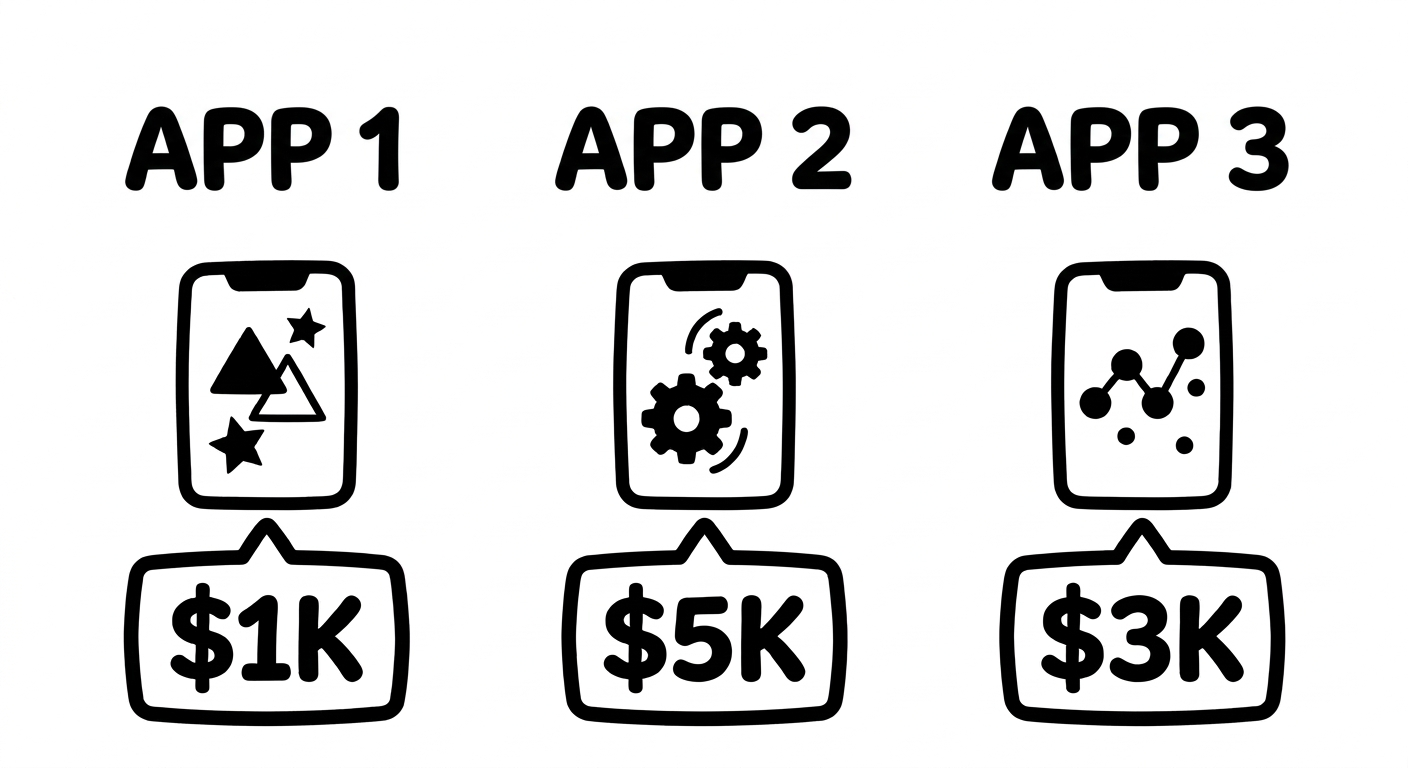
“The way to get good ideas is to get lots of ideas and throw the bad ones away.” – Linus Pauling
❓ What You’ll Learn
- Who launched 70+ projects with zero employees and reached $3.1M ARR?
- How do vibe coding tools make the portfolio model viable?
- What does practical portfolio math look like?
- What tools are still missing for operators managing 10-40+ apps?
- What is a portfolio OS category?
- Why could portfolio founders outperform single-product founders?
- Why do high failure rates push founders toward portfolio thinking?
- Is 5% hit rate of a portfolio a signal of success?
- Which $20-$50/app/mo service model turns the portfolio’s liability into a recurring revenue stream?
💎 Why It Matters
Solo founders are treating startup creation like a portfolio.
Ship fast, kill fast and find a few winners that cover the failures.
🔍 Problem
Putting everything into one product creates concentration risk.
Solo founders often need a long time to make steady money. This makes one-product bets fragile.
💡 Solution
Build many small products instead of one all-in bet.
Lower variance, double down on traction and retire weak apps early.
🏁 Players
Portfolio Operators
- Pieter Levels • 70+ projects, 4 made money (~5% hit rate). $3.1M ARR, zero employees. PhotoAI ($132,000/mo), RemoteOK ($41,000/mo), InteriorAI ($38,000/mo). Runs everything on vanilla PHP, jQuery, SQLite and a simple VPS
- Danny Postma • HeadshotPro made $300,000 in the 1st year. The portfolio includes TattoosAI, StockAI, ProfilePictureAI, Deep Agency.
- Marc Lou • 23 projects before finding his hit. $1.03M earned in 2025. ShipFast + CodeFast (~$20,000/mo each), DataFast ($15,800 MRR, growing 14% MoM), TrustMRR (built in 24 hours, now a verified startup marketplace with 120,000 visitors/mo and ~1 acquisition/day; turned down an acquisition offer)
- Tony Dinh • Vietnamese dev who quit corporate after 7 years. TypingMind ($130,000-$160,000/mo), DevUtils ($5,000/mo). ~$142,000/mo total. Sold BlackMagic.so for $128,000 after Twitter API pricing killed margins
- Erikas Malisauskas • $4.5M/year from a Shopify app portfolio. $100,000 marketing spend, ~90% margins. 5+ apps including Kaching Bundles and Kaching Post Purchase Upsell
Build Tooling
- Cursor • AI-powered code editor with 1M+ daily active users, $1B+ ARR, $29.3B valuation. 50%+ of Fortune 500 using it.
- Lovable • AI app builder that hit $100M ARR in 8 months (fastest ever). 10M+ projects built, 100,000/day. Raised $330M at $6.6B valuation.
- Bolt.new • Prompt-to-fullstack app builder. $40M ARR in 6 months, 5M signups.
- ShipFast • Next.js boilerplate, the category leader. Users launch in an average of 7 days. 7,200+ developers, $199 one-time. $130,000+/mo revenue.
Acquisition Marketplaces
- Acquire.com • The dominant marketplace for SaaS acquisitions ($50,000-$5M+)
- Flippa • Broadest marketplace: SaaS, content sites, ecommerce, apps
- Empire Flippers • Curated/vetted businesses at $100,000-$10M+
Portfolio Analytics and Billing
- ChartMogul • Subscription analytics supporting multiple billing systems and products in one view. Benchmarks against 2,500+ SaaS companies.
- Paddle • Merchant of record handling tax, payments and analytics globally. 5% + $0.50/tx. Run multiple products under one billing entity.
🔮 Predictions
- Portfolio founders will outearn single-product founders. The math favors portfolios at the median, not the top. As vibe coding tools push build time toward zero, the cost of adding another app drops below the cost of iterating on a failing one.
- Pieter Levels‘ hit rate is 5%, but his portfolio generates $3.1M ARR.
- The strategy works for the same reason index funds beat stock picking for most investors.
- If AI tools plateau and micro-apps require as much maintenance as full SaaS, the advantage erodes.
- We’ll see a “portfolio OS”. Portfolio operators are stitching together Stripe dashboards, separate analytics accounts and spreadsheets. There’s no unified tool for managing 10+ apps.
- Portfolio operators are already building one-off internal tools to solve pieces of the problem.
- If Stripe, Vercel or Railway add portfolio features as built-in capabilities, the standalone market shrinks.
- For now, this white space needs consolidated revenue tracking, shared auth, cross-app analytics, unified support.
- Vibe coding will produce a wave of undifferentiated apps, triggering a distribution crisis. When build cost goes to zero, supply floods. Lovable alone has produced 10M+ projects. Discovery becomes the bottleneck, not creation.
- Portfolio operators with existing audiences (Pieter Levels’ 800,000+ Twitter following, Marc Lou’s newsletter) will have a structural advantage.
- The pattern mirrors what happened to mobile apps in 2012-2014: the App Store went from curated to flooded and distribution became the moat.
- Improved app store algorithms and AI-powered discovery tools will help the supply glut self-sort faster than expected.
☁️ Opportunities
- Ship a portfolio operating system that gives founders a single view across all their products: combined MRR, churn by app, shared customer database, cross-app analytics and consolidated support inbox.
- Start with a dashboard that connects to Stripe, Plausible/PostHog and your hosting provider.
- Each operator has built one-off internal tools to solve pieces of this problem. When practitioners build their own tools, the productized version is overdue.
- Charge $49-$199/mo based on the number of connected apps. Small customer base but high-value.
- Offer distribution-as-a-service for micro-apps. As vibe coding floods the market, discovery becomes the bottleneck. Most portfolio founders rely on their personal audience for distribution. Founders without an audience have great products nobody sees. Max Huang credits ASO optimization as the key lever that boosted his portfolio metrics by 50%.
- Price at 10-15% of revenue driven or a flat monthly retainer.
- Handle ASO, Product Hunt launches, social media promotion, content marketing, influencer seeding for a portfolio of micro-apps.
- Launch an AI-powered app maintenance service. The hidden tax of the portfolio model is maintenance: dependency updates, security patches, uptime monitoring, bug fixes across 10-30 apps. Most portfolio founders do this manually or defer it until something breaks.
- Price at $20-$50/app/mo. A founder with 15 apps pays $300-$750/mo for peace of mind.
- The value proposition: turn your portfolio from a maintenance burden into a passive income stream.
- The AI tooling to build this exists today (Claude Code, GitHub Copilot, Dependabot). The integration layer is the product.
🏔️ Risks
- Revenue Concentration • Portfolios can still depend on 1 or 2 winners carrying the losses from other bets.
- Strategy Drift • Jon Yongfook says multi-project momentum requires resets when focus gets diluted.
- Channel Dependency • Portfolio diversification does not remove channel risk if growth relies on one lever (for example SEO/ASO).
🔑 Key Lessons
- The hit rate is 5%. The strategy is volume. Pieter Levels launched 70+ projects and 4 made money. Marc Lou shipped 23 before ShipFast became his breakout. You don’t need to predict which app will win. You need to make enough bets that the math works in your favor.
- Distribution is the moat, not code. Lovable has built 10M+ projects. The ability to build is no longer a scarce resource. You need an audience that will try what you build.
🔥 Hot Takes
- The “12 startups in 12 months” challenge will become the default onboarding path for new founders, replacing accelerators and MBA programs as the most effective way to learn startup fundamentals. You learn more while shipping 12 things than writing one business plan.
- The most valuable company in the micro-app space will be the portfolio OS that every operator runs on. The picks-and-shovels play wins in a gold rush.
😠 Haters
“Many of these ‘micro’ apps aren’t micro. Nomad List and HeadshotPro are real businesses.”
Fair. PhotoAI makes $132,000/mo. HeadshotPro made $300,000 in the 1st year. These aren’t weekend side projects. But the “micro” refers to the initial bet size, not the ceiling. Levels didn’t plan for PhotoAI to be his biggest product. He built 70+ things and let the market pick the winner. Most apps in a portfolio start micro and some grow into full businesses.
“You’re building a graveyard of half-finished products, not a portfolio.”
The maintenance burden is real. At 10+ apps, the operational overhead can overwhelm a solo founder. Most founders who attempt the portfolio model will underestimate the compounding cost of keeping many products alive. The 5% hit rate means 95% of your portfolio is dead weight that still needs periodic attention.
“Survivorship bias is doing all the heavy lifting here.”
We hear about Pieter Levels and Danny Postma because they succeeded publicly. The Indie Hackers graveyard is full of founders who shipped 10 apps, none of which found traction and burned out. The 92% SaaS failure rate doesn’t improve with volume if the fundamental issue is distribution, not product.
“Vibe-coded apps are a race to the bottom. Zero moat, zero defensibility.”
If you can build it in 24 hours, so can your competitor. When build cost goes to zero, the only remaining moats are distribution, brand and data. The winners will be founders who pair speed-to-ship with genuine distribution advantages, not founders who ship the most.
“The portfolio model is really a lifestyle business ceiling dressed up as a strategy.”
Solo founders running portfolios often cap out at $3M-$5M ARR because there’s no organizational leverage. You can’t hire without changing the economics. You can’t raise without changing the model. The portfolio model is great for earning $500,000-$3M per year, but that ceiling is real. For founders who want venture-scale impact, the portfolio model is a detour.
“Platform risk doesn’t disappear with diversification: it multiplies.”
A portfolio spread across Apple, Google, Stripe and various hosting providers means you’re exposed to each platform’s terms of service changes. A Stripe policy change could freeze payments for your entire portfolio. Diversification across products doesn’t equal diversification across platforms. The correlation risk is higher than it appears.
🔗 Links
- Here’s How These Founders Are Building Multiple Products at Once • A candid look at what breaks first when you run multiple products: focus, systems, or stamina.
- How I Manage Running Multiple Products of $18,000/mo Total Revenue • A practical operating snapshot of what “portfolio mode” looks like day to day when one person is juggling everything.
- How I Launched and Maintain Multiple Products at the Same Time • A first-person account of juggling build cycles, maintenance, and motivation across products in parallel.
📈 Want the full picture?
Who rebuilt a $60,000/mo app portfolio after losing $34,000/mo overnight to a single platform ban?
How does a 23-year-old run a mobile app portfolio generating $185,000/mo with no venture backing?
Is there a cap to the solo portfolio model at 90%+ margins?
Why are boilerplates at $130,000+/mo today actually a dead category walking?
How do you build a portfolio CFO service where founders running 10-30 revenue streams across multiple Stripe accounts will pay premium rates?
Why will the first solo founder to cross $10M ARR trigger a wave of $300,000-$500,000 big tech exits?
Trends Pro has the answers. Plus 14 players, 7 predictions, 8 opportunities and 13 links.
Get Weekly Reports
Join 54,000+ founders and investors
📈 Unlock Pro Reports, 1:1 Intros and Masterminds
Become a Trends Pro Member and join 1,200+ founders enjoying…
🧠 Founder Mastermind Groups • To share goals, progress and solve problems together, each group is made up of 6 members who meet for 1 hour each Monday.
📖 160+ Trends Pro Reports • To make sense of new markets, ideas and business models, check out our research reports.
💬 1:1 Founder Intros • Make new friends, share lessons and find ways to help each other. Keep life interesting by meeting new founders each week.
💲 100k+ Startup Discounts • Get access to $100k+ in startup discounts on AWS, Twilio, Webflow, ClickUp and more.
Brought to you by the team behind HeadsUp
