
AI Dating Assistants: Authenticity Paradox, Dating Fatigue, Agentic Matchmaking

“People don’t want to buy a quarter-inch drill. They want a quarter-inch hole.” – Theodore Levitt

Get Full Access to Trends Pro

❓ What You’ll Learn

  • How are solo founders hitting 8 figures while the big dating apps keep shrinking?
  • Which pricing model turns a churning Rizz app into a durable business?
  • Where is the open ground the “pickup line” crowd keeps ignoring?
  • How do you build for a market that uses AI freely yet punishes anyone caught using it?
  • Why will agent-to-agent screening run the top of the funnel before two humans ever meet?
  • What makes a screenshot-to-reply wrapper a thin moat anyone can clone in a weekend?
  • Why is the profile photo the highest-leverage variable nobody closes the loop on?


💎 Why It Matters

AI dating usage jumped 333% in a year while the apps it runs on keep losing paying users.

The hardest part of dating just got handed to a model.


🔍 Problem

Dating apps made matching free and frictionless. They still haven’t solved the conversation.

The bottleneck moved from getting matched to knowing what to say.


💡 Solution

AI dating assistants coach a real person to talk to other real people.

You screenshot a stalled chat or a profile.

A multimodal AI model reads the context and hands back openers, replies and profile fixes.


🏁 Players

Reply and Opener Generators

  • Rizz • The category-definer. Screenshot a stalled chat, get replies in a chosen tone. Over 7.5M downloads since 2022.
  • YourMove AI • The most complete text toolset: openers, reply suggestions and profile rewrites in one app.
  • Plug AI • Screenshot or selfie in, pickup lines and comebacks out, across the major apps.

Profile and Photo Optimization

  • Roast • Upload selfies, get an AI photo critique plus an AI-generated dating photoshoot, purpose-built for dating apps.
  • PhotoAI • Trains on a handful of selfies to generate dating and headshot photos. Profitable solo business, 29.7M photos generated.
  • DatePhotos.AI • Dating-specific photo generator that returns 80 to 180 shots across 40-plus scenes, each scored for realness.

AI Matchmaking

  • Sitch • Concierge AI matchmaker that sells curated introductions in setup packs, no infinite swipe deck.
  • Iris Dating • Learns your facial preferences and acts as a personal matchmaker.
  • Keeper • AI matchmaker for marriage-minded users, pairing AI suggestions with human review. Raised a $4M pre-seed.

Incumbent Platforms

  • Hinge • Shipped AI Convo Starters and Prompt Feedback to push stalled matches into conversations.
  • Bumble • Added AI photo feedback and is testing an AI matchmaker to replace the swipe.
  • Tinder • Match Group is pouring AI investment into fixing the matching experience.


🔮 Predictions


☁️ Opportunities

  • Build a photo-to-match-rate optimizer that bills on measured lift.
    • Roast generates and rates photos but stops short of closing the loop on real match-rate gains.
    • The photo is the highest-leverage variable in the funnel, so tie the price to the result.
  • Charge for dates booked, billed on the outcome the user actually wants.
    • The closest proof is matchmaking sold by the introduction, where Sitch charges per setup.
    • Billing on dates forces you to capture which conversations convert, the one signal a phone keyboard can’t see.


🏔️ Risks

  • Thin Moat • Most apps are a prompt over a model anyone can call, so price and novelty erode fast.
  • Channel Decline • The dating apps these tools depend on keep losing paying users.
  • Abuse Surface • The same engine that helps a shy person also industrializes romance scams.


🔑 Key Lessons

  • The only metric worth owning is the date itself. Messages are free to copy, so they make a worthless moat, while real-world meetings are the one signal platforms can’t see inside your app.
  • Build the tool users are meant to outgrow. A fake persona collapses on the first date, so the product that visibly builds skill survives the authenticity backlash and earns referrals.


🔥 Hot Takes

  • Charisma just became a monthly subscription.
  • In a few years your profile dates for you, screening matches before you ever swipe.


😠 Haters

“Two bots flirting with each other isn’t a relationship.”
Fair. The fake-persona apps deserve to fail when the witty texter freezes in person. The tools that coach genuine skill survive the first date because the user actually improved.

“Why would I pay for this when ChatGPT is free?”
For most people the wedge is the screenshot-to-reply speed and the dating-specific tone, not raw capability. The apps that survive own a distribution channel or outcome data that a generic chatbot can’t match.


🔗 Links

  1. Rizz Co-Founder Q&A • The category-definer explains the screenshot-to-reply playbook in his own words.
  2. Every Dating App Has AI Now • How the incumbents bolt AI onto matching and whether it helps.
  3. The New Rules of Online Dating: Swipes, Scams, and Synthetic Charm • Nearly half of US daters report being scam-targeted, with AI profiles and chatbots industrializing the same playbook honest assistants use.


📈 What else?

Trends PRO #0167: AI Dating Assistants has more insights.

What you’ll get:

  • 22 Players (83% more)
  • 5 Predictions (150% more)
  • 5 Opportunities (150% more)
  • 5 Risks (67% more)
  • 5 Key Lessons (150% more)
  • 4 Hot Takes (100% more)
  • 7 Links (133% more)

With Trends Pro you’ll learn:

  • (📈 Pro) Who raised $6M to book 2,000 real dates a month without a swipe deck?
  • (📈 Pro) Why does distribution beat the feature when the reply generator clones in a weekend?
  • (📈 Pro) How do you launch the verified-human counter-brand before AI openers flood every inbox?
  • (📈 Pro) Why will incumbents ship first-party AI and choke third-party reply tools?
  • (📈 Pro) Why does winning at matchmaking wreck your unit economics?
  • (📈 Pro) How do you sell the safety and age-verification layer apps can’t build in-house?
  • (📈 Pro) Why is “human-verified” becoming the next status symbol on a profile?
  • (📈 Pro) Why do dating apps fear you not needing them more than AI-on-AI dates?
  • And much more…

Get Weekly Reports

Join 54,000+ founders and investors


    📈 Unlock Pro Reports, 1:1 Intros and Masterminds

    Become a Trends Pro Member and join 1,200+ founders enjoying…

    🧠 Founder Mastermind Groups • To share goals, progress and solve problems together, each group is made up of 6 members who meet for 1 hour each Monday.

    📖 160+ Trends Pro Reports • To make sense of new markets, ideas and business models, check out our research reports.

    💬 1:1 Founder Intros • Make new friends, share lessons and find ways to help each other. Keep life interesting by meeting new founders each week.

    💲 100k+ Startup Discounts • Get access to $100k+ in startup discounts on AWS, Twilio, Webflow, ClickUp and more.


    Brought to you by the team behind HeadsUp

    🧠 What Will AI-Powered Habit Change Actually Look Like?


    This week’s Founder Finds includes:

    ♟️ When to quit?
    💵 Naval on sales
    🗂️ A bookmark manager
    🧠 AI-powered habit change
    🤖 An introduction to Hermes
    ➡️ And more…


    🪶 Remember This

    Success is the sum of small efforts repeated daily.


    🤓 Fav Finds

    Tools, tweets and more from Trends Pro Members


    💵 Naval on Sales shared by Barun Pandey
    A podcast episode with Naval


    🗂️ Raindrop.io shared by Stan Wilson
    An all-in-one bookmark manager tool


    🤖 Why I’m Switching to Hermes shared by Elia Zane
    An introduction to using Hermes Agent


    🏆 Trends Pro Member Wins

    🚧 Dru Riley published Consistent But No Progress? It’s the Hurdle Rate, on how consistency can kill you


    📅 Maciej Cupial launched Calendesk in the ChatGPT Store


    🤖 Alexandre Kantjas is hosting a workshop on Claude Cowork


    Elie Steinbock launched a fantasy football game for the World Cup


    🎧 Listen To

    What Will AI-Powered Habit Change Actually Look Like?

    Here’s a breakdown of what the military figured out that most productivity advice misses.

    • Understand the cue-routine-reward loop. The brain doesn’t distinguish between good and bad habits. It just runs the loop automatically, which means you can hack it by changing the cue or the reward.
    • Design for immediate rewards. Habits tied to long-term goals (saving money, losing weight) fail because the brain needs a near-term payoff to reinforce the loop.
    • Treat willpower like a battery. It depletes throughout the day, which is why planning for relapse matters more than hoping you’ll stay strong.


    🛠️ Tools of the Week

    🎞️ Multi — Grow on YouTube on autopilot


    🧿 HeadsUp.bot — Stay ahead of competitors


    Charm — Get customers through Google and AI Search


    💵 StockDrifts — Visual stock research that builds conviction fast


    ❔ Ask Yourself

    How Does “Train the Monkey” Mental Model Save Founders Millions?

    Annie Duke is a decision science expert and former poker pro. She says that founders who learn to quit are building better companies than those who never do.

    • Recognize pivot as a quit. Stewart Butterfield quit building an online game and made Slack. The Notion founders threw out all their code and rebuilt from scratch.
    • Set kill criteria. Write down specific states and dates. “If by [date] I haven’t reached [specific metric], I quit.” Doing this early is the only way to avoid moving the goalposts when you’re inside the failure.
    • Tackle the monkey before the pedestal. Find the hardest, most uncertain part of your idea first. Every “low hanging fruit” you pick before solving the bottleneck creates sunk costs and an illusion of progress.


    🔧 Try This

    60 Seconds to Your First Competitive Insight

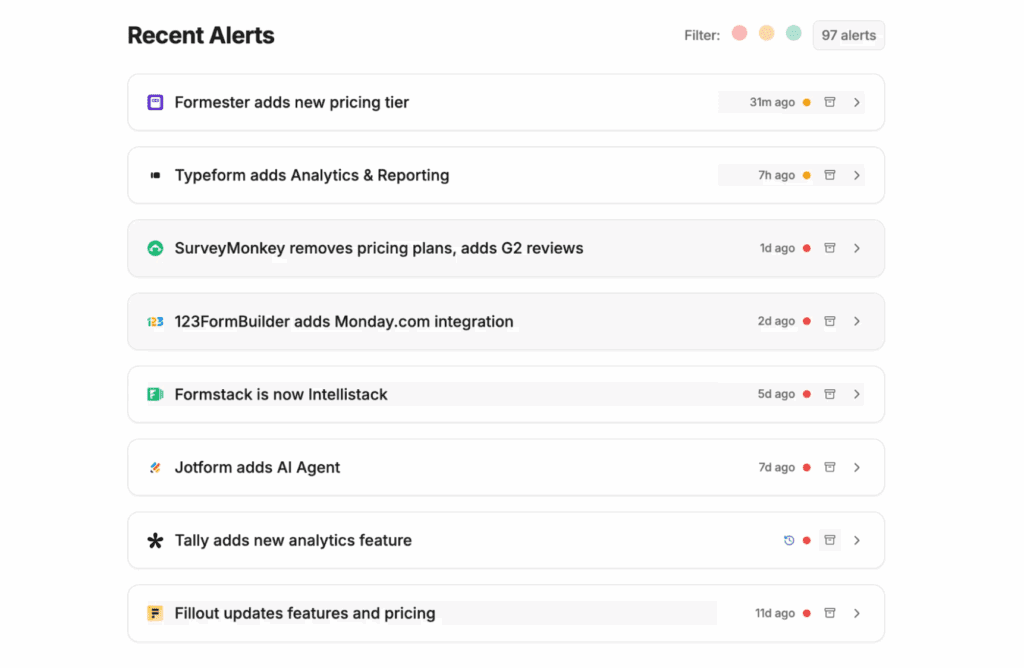
    HeadsUp is an AI-powered competitive intelligence platform that watches your market 24/7.

    It doesn’t just tell you what changed… It tells you what to do about it.

    🏆 #1 Product of the Day on Product Hunt

    Get 90 days of competitor intelligence in 60 seconds with HeadsUp:

    • See what you’ve been missing (pricing, features, positioning)
    • Know what to do about it, not just what happened
    • Get weekly briefs summarizing what matters

    See what you’ve been missing 👉 Try HeadsUp free


    The Most Popular Link From Last Week:
    💧 AI Agent Monitoring​ Platform

    Get Weekly Reports

    Join 54,000+ founders and investors


      📈 Unlock Pro Reports, 1:1 Intros and Masterminds

      Become a Trends Pro Member and join 1,200+ founders enjoying…

      🧠 Founder Mastermind Groups • To share goals, progress and solve problems together, each group is made up of 6 members who meet for 1 hour each Monday.

      📖 160+ Trends Pro Reports • To make sense of new markets, ideas and business models, check out our research reports.

      💬 1:1 Founder Intros • Make new friends, share lessons and find ways to help each other. Keep life interesting by meeting new founders each week.

      💲 100k+ Startup Discounts • Get access to $100k+ in startup discounts on AWS, Twilio, Webflow, ClickUp and more.


      Brought to you by the team behind HeadsUp

      Personal AI Agents: Skill Marketplaces, Compliance Wedge, Open Weights

      “The cloud is just someone else’s computer.” – Chris Watterston

      Get Full Access to Trends Pro

      ❓ What You’ll Learn

      • Where are the biggest founder opportunities in the owned-agent stack?
      • Why is the most personal piece of your stack still someone else’s server?
      • How did one side project pull 60,000 GitHub stars in 72 hours?
      • Why did messaging beat model quality as the wedge prosumer builders actually picked?
      • How do foundation-stewarded agents outlast their creators the way Linux did?
      • Can open-weight models match GPT-4-class agentic performance on a self-hosted budget?
      • What does the rented-to-owned migration playbook look like and who pays for it first?
      • Why does an open agent with shell access create a security surface most founders still underestimate?
      • Why is a signed skill audit standard the gate before the first Fortune 500 agent deployment?
      • Why does a closed-source SaaS personal agent fail the durability test most founders skip?
      • Which regulatory deadline turns self-hosted compliance into a forced migration?


      💎 Why It Matters

      OpenClaw picked up 60,000+ GitHub stars in 72 hours.

      The agent layer chose open-source.


      🔍 Problem

      Your assistant lives on someone else’s server.

      Your context, habits and second brain sit inside a container you do not own.

      The most personal piece of your stack is rented.


      💡 Solution

      Open-source agents running on open-weight models are replacing rented assistants for the prosumer and builder segment.


      🏁 Players

      Coding Agents

      • Open Interpreter • Natural language replaces bash. $5M raised from a16z. Reference implementation for the owned-agent thesis.
      • Cline • VS Code-native autonomous coding agent. Highest-velocity open coding agent on GitHub.
      • OpenHands • Autonomous coding agent. 40,000+ stars. MIT license. Ranks competitively on SWE-Bench against closed-source alternatives.

      Personal Knowledge Agents

      • Khoj • Self-hostable personal AI over your notes, files and email. Closed-source cloud tier funds the open version.
      • OpenClaw • Self-hostable personal agent over your files, tools and persistent memory. 60,000+ stars in 72 hours under foundation stewardship.

      Open-Weight Model Engines

      • Hermes • Fine-tuned Llama variants optimized for tool calling and structured output. Post-training as the agentic lever.
      • Llama • The gravity well of open-weight models. Released open to commoditize the layer below Meta’s monetization.

      Local Runtimes

      • Ollama • Default CLI runtime for local open-weight models. Largest community, most third-party integrations.
      • LM Studio • GUI runtime for non-technical users running local models.

      Owned Hardware

      • Plaud • Clip-on AI recorder. Profitable, $30M ARR reported. Device keeps recording even if the AI service goes dark.


      🔮 Predictions

        • The OpenClaw foundation will publish a signed skill audit standard before the first Fortune 500 deployment.
        • An open-weight model will match GPT-4-class agentic performance on a self-hosted budget.
          • DeepSeek R1 already matches closed-source on reasoning benchmarks at a fraction of training cost.
          • Qwen leads open-weight benchmarks at most sizes with agent-specific tuning.
          • Hermes from Nous Research post-trains base models specifically for tool calling and structured output.


        ☁️ Opportunities

        • Launch an audited skill marketplace for OpenClaw and other open-source agents.
          • Documented exfiltration in a third-party OpenClaw skill is already in published research.
          • Curation, signed releases and sandboxed execution is the npm + Snyk play for agent skills.
          • Distribution wedge is to ship a CLI that becomes the drop-in for openclaw install.
        • Ship rented-to-owned migration tools that pull a user’s history out of ChatGPT, Gemini and Granola.
          • Users sitting on years of ChatGPT memory have no clean export path.
          • Viral surface is the “I moved off ChatGPT in 10 minutes” before-and-after share.
          • Granola transcripts, Friend conversations and Operator histories are similarly trapped.
        • Run an observability layer for self-hosted personal agents. OpenTelemetry as the shared standard. Plug into every Tier 1 agent.
          • Self-hosters operate blind. No logs, no traces, no token-cost dashboards across Ollama, Open Interpreter, OpenClaw and others.
          • Buyer is the prosumer running 3+ open agents who wants to know which one is actually working.
        • Own a vertical owned-agent for one regulated industry.
          • Legal, medical, financial and education each become a separate productized package.
          • EU AI Act August 2026 deadline makes self-hosted open-source easier to defend than rented closed-source.
          • The model is the commodity. The vertical wrapper with compliance docs and pre-vetted prompts is the product.


        🏔️ Risks

        • Security Surface • OpenClaw has documented prompt-injection susceptibility and at least one third-party skill caught performing data exfiltration.
        • Feature Lag • Open-source agents trail closed-source on cutting-edge features by 3-6 months on average.
        • UX Gap • Most owned agents still require terminal comfort. The non-developer hasn’t arrived.


        🔑 Key Lessons

        • Owned beats rented over a five-year arc, every category. Email, files, search, social, hosting. Personal agents are mid-cycle and the prosumer segment moves first.
        • The interface is the wedge. The model is the commodity. OpenClaw won 60,000 stars in 72 hours because of messaging-as-interface, not because of model quality. Repeat that until it sticks.
        • Foundations decouple projects from founders. The OpenClaw foundation transition (announced when Steinberger joined OpenAI) is the same move Linux, PostgreSQL and Python used to outlast their creators.


        🔥 Hot Takes

        • The first billion-dollar owned-agent unicorn is open-source, foundation-stewarded and monetized via a hosted convenience tier.
        • OpenClaw is the agent layer’s Postgres moment. Public infrastructure under a foundation outlives any single VC bet.


        😠 Haters

        “Open-source agents are 6 months behind closed-source. They always will be.”
        The gap closes every cycle. Cline shipped autonomous file editing months before Cursor polished the same feature. OpenHands ranks competitively with closed-source coding agents on SWE-Bench.

        “I’d never let an open-source agent touch my email.”
        Trust is a fair concern. The owned-agent answer is sandboxed execution, capability-based permissions and audit logs you can read yourself. Most rented services give you none of that and still get the email access.

        “Running a local agentis too technical. Most people won’t configure it.”
        Today, mostly true. Ollama already collapsed the install step for local models from ML-engineer to one-command. The agent layer is on the same curve and will ship polished 1-click setups.

        “Founders building on open agents are rebuilding what OpenAI ships next quarter.”
        The opposite. OpenAI ships the rented version. Founders shipping the owned version capture the segment OpenAI structurally cannot serve. The two categories coexist the way Linux and Windows coexisted for 20 years.


        🔗 Links

        1. OpenClaw: The Viral AI Agent • Three hours with Peter Steinberger on the one-hour prototype, the rename wars, Moldbook, security and why agents replace 80% of apps.
        2. Your New Assistant or a Security Disaster? • A plain-language explainer on what happens when your assistant runs shell commands on your laptop and talks to you on WhatsApp.
        3. Ask HN: Who Is Using OpenClaw? • Practitioners debating Obsidian-as-memory, container lockouts and why vendor-neutral context beats a smarter model swap.


        📈 What else?

        Trends PRO #0166: Personal AI Agents has more insights.

        What you’ll get:

        • 24 Players (140% more)
        • 7 Predictions (133% more)
        • 8 Opportunities (100% more)
        • 6 Risks (100% more)
        • 6 Key Lessons (200% more)
        • 6 Hot Takes (200% more)
        • 13 Links (333% more)

        With Trends Pro you’ll learn:

        • (📈 Pro) Which $10M ARR agent-app-store hit emerges first, and what marketplace shape captures the upside?
        • (📈 Pro) What changes for owned-agent founders when Apple opens a developer API for Apple Intelligence agent extensions?
        • (📈 Pro) Why does the device-outlives-the-cloud playbook beat every other hardware bet in this category?
        • (📈 Pro) How to ship a bring-your-own-agent voice stack that plugs into any open-source agent?
        • (📈 Pro) Why is foundation drift in year one a real stagnation window after the creator leaves?
        • (📈 Pro) Why will the rented-agent era end the way Hotmail did?
        • (📈 Pro) How does the Fortune 500 IT wedge open for one Tier 1 open-source agent first?
        • (📈 Pro) How did Felix the agent earn $177,417 before the founder got interviewed?
        • (📈 Pro) What 7 components should your personal agent infrastructure have?
        • (📈 Pro) Why should you have 156,926 agent memories of yourself?
        • (📈 Pro) Why does the harness matter more than the model when building an Agent OS?
        • And much more…

        Get Weekly Reports

        Join 54,000+ founders and investors


          📈 Unlock Pro Reports, 1:1 Intros and Masterminds

          Become a Trends Pro Member and join 1,200+ founders enjoying…

          🧠 Founder Mastermind Groups • To share goals, progress and solve problems together, each group is made up of 6 members who meet for 1 hour each Monday.

          📖 160+ Trends Pro Reports • To make sense of new markets, ideas and business models, check out our research reports.

          💬 1:1 Founder Intros • Make new friends, share lessons and find ways to help each other. Keep life interesting by meeting new founders each week.

          💲 100k+ Startup Discounts • Get access to $100k+ in startup discounts on AWS, Twilio, Webflow, ClickUp and more.


          Brought to you by the team behind HeadsUp
          😵 How Did a Google Engineer Burn $538K on a $147/Month Product?


          This week’s Founder Finds includes:

          💧 AI agent monitoring
          🎨 A design prompt library
          💸 Hermes + DeepSeek V4
          😵 An indie founder reality check
          🚀 Agile principles for life planning
          ➡️ And more…


          🪶 Remember This

          Action is the foundational key to all success.


          🤓 Fav Finds

          Tools, tweets and more from Trends Pro Members


          💸 Making Hermes 100X Cheaper shared by Hitesh Kar
          A video on integrating Hermes with DeepSeek V4


          💧 Raindrop shared by Stew Fortier
          A monitoring platform for AI agents


          🎨 Design Prompt Library shared by Elie Steinbock
          Curated prompts for beautiful landing page design


          🏆 Trends Pro Member Wins

          ♟️ Dru Riley published 5 Things Chess Teaches Us About Life, on freedom and obligations 


          💬 Mike Williams published a prompt library for marketplaces


          😴 Wojtek Wozniak shipped LazyOS


          💻 Eddie Forson wrote about AI adoption


          📘 Read This

          How Did a Google Engineer Burn $538K on a $147/Month Product?

          A Google engineer quit his $220,000 job, burned through his savings and ended up with $147 MRR.

          Here’s the mistakes he made:

          • Skipped the most important step. Talked to 0 customers before building.
          • Priced like a hobby. $29/month signaled “not serious software”. He couldn’t raise prices with only 3 customers.
          • Learned the one thing X never shows. For every “I hit $10K MRR in 3 months” post, there are 1,000 people making $0 and staying quiet.


          🛠️ Tools of the Week

          🎞️ Multi — Grow on YouTube on autopilot


          🧿 HeadsUp.bot — Stay ahead of competitors


          Charm — Get customers through Google and AI Search


          💵 StockDrifts — Visual stock research that builds conviction fast


          ✍️ Biography of the Week

          Lee Kuan Yew: Engineered Sovereignty

          Lee Kuan Yew built one of the most efficient states in modern history. 

          He also kept his party in power for fifty-six years through defamation lawsuits, detention without trial and a salary scale designed to make political loyalty pay. 

          You’ll see how a Cambridge-trained lawyer turned a 581-square-kilometer island into the model the rest of the Asian Tigers studied.

          Listen to the episode (22 min) →

          Read the full biography →


          ❔ Ask Yourself

          Why Should You Plan Your Life Like a Software Product?

          Natalia spent 3 years treating her life like a software product and found a system that actually works:

          • Design “MVP habits”. Instead of “1 hour at the gym or nothing,” your minimum viable habit is the version you can do on your worst day. 5 minutes of stretching in pajamas counts.
          • Use the 70% buffer rule. Plan for only 70% of your capacity. The other 30% absorbs fatigue and unexpected calls.
          • Run retrospectives every 2 weeks to find the system error. “I keep eating sweets late at night” is a bug to fix.


          🔧 Try This

          60 Seconds to Your First Competitive Insight

          HeadsUp is an AI-powered competitive intelligence platform that watches your market 24/7.

          It doesn’t just tell you what changed… It tells you what to do about it.

          🏆 #1 Product of the Day on Product Hunt

          Get 90 days of competitor intelligence in 60 seconds with HeadsUp:

          • See what you’ve been missing (pricing, features, positioning)
          • Know what to do about it, not just what happened
          • Get weekly briefs summarizing what matters

          See what you’ve been missing 👉 Try HeadsUp free


          The Most Popular Link From Last Week:
          📊 AI-Powered Marketing Attribution

          Get Weekly Reports

          Join 54,000+ founders and investors


            📈 Unlock Pro Reports, 1:1 Intros and Masterminds

            Become a Trends Pro Member and join 1,200+ founders enjoying…

            🧠 Founder Mastermind Groups • To share goals, progress and solve problems together, each group is made up of 6 members who meet for 1 hour each Monday.

            📖 160+ Trends Pro Reports • To make sense of new markets, ideas and business models, check out our research reports.

            💬 1:1 Founder Intros • Make new friends, share lessons and find ways to help each other. Keep life interesting by meeting new founders each week.

            💲 100k+ Startup Discounts • Get access to $100k+ in startup discounts on AWS, Twilio, Webflow, ClickUp and more.


            Brought to you by the team behind HeadsUp

            AI Employees: Named Personas, Cautionary Tale, Outcome Pricing

            “I have 42,000 biological employees, and I’m going to have hundreds of thousands of digital employees.” – Jensen Huang, NVIDIA

            Get Full Access to Trends Pro

            ❓ What You’ll Learn

            • How did Sierra reach $150M ARR in 21 months by selling support agents instead of support software?
            • Which AI Employee pricing model collapses first when buyers compare $3 per resolution to a $150,000/year flat contract?
            • Where can a solo founder ship a $1,500-$3,000/mo vertical AI Employee before Sintra and Lindy own the SMB lane?
            • Why will at least one frontier lab ship a first-party AI Employee SKU under its own brand?
            • Why will the self-hosted lane (OpenClaw, Hermes) cannibalize SaaS AI Employees in the SMB tier first?
            • How does the 11x $14M-claimed vs $3M-contracted ARR gap turn into a picks-and-shovels opportunity?


            💎 Why It Matters

            The headcount budget just became the biggest software budget.


            🔍 Problem

            A CRM does not generate pipelines. 

            A ticketing system does not resolve tickets. 

            An accounting platform does not close the books.

            Each category required a human operator who was the bottleneck.


            💡 Solution

            Specialized AI workers are replacing the human roles.

            Sold as a single job with a monthly fee and outcome accountability.


            🏁 Players

            Customer Support

            • Sierra • Platform for building and running AI customer agents across chat, SMS, WhatsApp, email, voice and assistant surfaces, with tooling to design agents from SOPs and transcripts, monitor conversations and iterate without heavy engineering.
            • Decagon • Enterprise “AI concierge” for support: natural-language workflow definitions, omnichannel voice and chat, testing and analytics so agents stay on-brand and measurable.

            Specialist Professional Work

            • Harvey • Legal AI layer for firms and in-house teams: domain assistants and workflow agents for research, drafting, diligence and review grounded in your documents and systems.
            • Cognition (Devin) • Autonomous “AI software engineer” that takes multi-step coding work to completion (migrations, refactors, reviews, tickets and on-call-style tasks) inside your repos and toolchain.
            • Pilot • AI Accountant that runs the bookkeeping cycle: categorization, reconciliation, vendor ID and monthly close, with plain-English Q&A on your books in Pilot’s portal.

            Sales (SDR/BDR)

            • 11x • Named digital workers for revenue: Alice runs multi-channel prospecting and sequences; Julian handles AI phone outreach, marketed as always-on pipeline and meeting generation.
            • Artisan • Ava, an autonomous AI BDR: finds and enriches leads, runs personalized email and social sequences, tests copy, handles replies and books meetings inside one outbound stack.

            Recruiting and HR

            • Paradox • Conversational hiring stack centered on Olivia: apply, screen, schedule, interview, offers and onboarding by chat/text, in many languages, alongside a conversational ATS and career sites.
            • Mercor • Expert network and work marketplace that matches vetted specialists to paid roles training, evaluating and improving frontier AI systems.

            Multi-Role Platforms

            • Sintra • SMB-focused suite of named AI “employees” (BD, support, SEO, social, VA, sales, etc.) you onboard with brand context and tool connections. One workspace, role-specific chat agents.
            • Lindy • AI work assistant for inbox, calendar, meetings and follow-ups across email, Slack, CRM and more; build agents from prompts, delegate by SMS, and (on higher tiers) use cloud computer-style autopilot for UI work.

            Self-Hosted

            • OpenClaw • Open-source autonomous assistant you self-host: connect Slack, Discord, WhatsApp, Telegram, email and more to the models you choose, with tools, memory and automation hooks.
            • Hermes Agent • Open MIT-licensed agent runtime with persistent memory, growing skill files, multi-channel gateways, sandboxed execution and browser automation, designed to improve the longer it runs.


            🔮 Predictions

            • Outcome-based pricing will become the dominant pricing model for AI Employees.
              • Decagon and Sierra already price per-resolution on parts of their contracts.
              • Buyers can compare $3/resolution against $150,000/year flat with simple math.
              • The vendor that prices fully on outcomes first creates an unwinnable comparison.
            • At least one frontier lab will ship a first-party AI Employee SKU under its own brand.
              • OpenAI Operator, Anthropic’s computer-use API and Microsoft Copilot Agents all point at the same packaging move.
              • The lab that ships “Claude Customer Support Agent” can collapse application-layer gross margin to near-zero.
              • Frontier labs already own the developer relationship, the model and the trust certification.
            • Another AI Employee unicorn will land in the spotlight the way 11x did. Exposing the gap between claimed and contracted ARR.
              • 11x claimed $14M ARR vs ~$3M past break clauses, per the TechCrunch investigation.
              • 70-80% of early 11x customers used break clauses to exit after the AI underperformed human SDRs.
              • The same annual-contract-plus-3-month-break-clause pricing structure is in use at multiple mid-tier players today.


            ☁️ Opportunities

            • Ship vertical skill packs for self-hosted AI Employees (Hermes Agent, OpenClaw) priced at $50-$300/mo.
              • Hermes Agent and OpenClaw are horizontal runtimes that install as blank agents.
              • “Hermes Paralegal Pack” or “OpenClaw SDR Pack” loads the contract-review, citation-checking, outbound-sequence and CRM-connector skills on install.
              • The Awesome-Hermes-Agent list is already curating skills for free. Turn it into a paid marketplace.
            • Launch a vertical AI Employee for owner-operator SMBs (HVAC, plumbing, dental, real estate, accounting practices) priced at $1,500-$3,000/mo.
              • Pilot serves venture-startup bookkeeping but nobody ships “AI Bookkeeper for plumbing companies.”
              • The HVAC/electrical/landscaping owner has the same job-not-headcount problem as a Series B and a fraction of the SaaS sophistication.
              • Wire the AI persona into the vertical’s dominant ops tool (QuickBooks for trades, Dentrix for dental) and price against a part-time human in that role.
            • Launch a vertical AI recruiter for underserved industries (trades hiring, licensed-healthcare hiring, security-cleared roles).
              • Paradox owns frontline hiring at scale but ignores trades, allied health and cleared workforces.
              • Trades hiring is currently $1,500-$4,000 per placement; an AI recruiter at $500/placement undercuts the lane while expanding it.
              • Local trade unions and apprentice programs are the first distribution channel.
            • Sell outcome verification audits to AI Employee buyers.
              • 11x showed why customers cannot trust vendor-reported numbers. The $14M-vs-$3M ARR gap proves the picks-and-shovels demand.
              • Ingest a customer’s outcome logs from Sierra, Harvey, EvenUp or Pilot and produce a monthly “did your AI Employee earn its salary” report.
              • First customers are the post-11x burned cohort. Sales motion is “the report ZoomInfo wishes it had run sooner.”


            🏔️ Risks

            • Outcome Gap • The named persona implies a capability the underlying model cannot consistently deliver against the human equivalent.
            • Metaphor Failure • The “employee” framing breaks the first time a customer needs to fire, retain or counter-offer the AI and finds only a cancellation form.


            🔑 Key Lessons

            • Packaging beats capability when the buyer’s mental model already exists. Sierra and Harvey did not win because their models were categorically better. They won because the headcount budget is bigger than the software budget and line managers already know how to procure an employee.
            • The definite article and the first name are the category boundary. “The AI Accountant,” “Alice the AI SDR,” “Devin the AI Software Engineer.” If the product cannot be introduced as a single person on a Slack channel, it is not in the category.
            • Outcome metrics will rewrite the pricing surface within 18 months. Per-seat pricing is incoherent for an employee. The vendor that prices fully on outcomes first creates an unwinnable comparison.


            🔥 Hot Takes

            • The new line item in the 2027 P&L is AI Headcount. Finance teams will move agent spend out of software once they realize the budget pool is wrong.
            • SaaS company valuations re-rate down within 24 months. The buyer asks “what does she ship per month?” and the seat-based vendor has no answer.


            😠 Haters

            “You’re calling a subscription an employee to inflate the price tag.”
            Headcount budget pools are bigger than SaaS budget pools and line managers already know how to procure, evaluate and fire an employee. The naming is a sales technique that maps to a buyer ritual that already exists.

            “Look at 11x. The whole category is outcome theater.”
            11x exposed a pricing structure (annual contracts with 3-month break clauses and lead-volume pricing) that hides churn until it lands all at once. Sierra at $150M ARR, Harvey at $190M ARR and Pilot’s autonomous close are the counter-example. Those numbers passed audit cycles.

            “Frontier labs will eat this lane in a quarter.”
            They might eat the horizontal lane. The vertical and regulated lanes need domain expertise, custom integrations and compliance certifications that take 18-36 months to build. The Harvey-Cognition-Pilot tier wins by being too specialized to absorb cleanly.

            “This is just GPT wrappers in a costume.”
            Every successful application layer in the last decade was “just a wrapper” on something. Salesforce was a wrapper on a database. Stripe was a wrapper on card networks. The packaging is the product when the buyer’s job changes from configuration to procurement.


            🔗 Links

            1. Pilot Unveils AI Accountant • The first fully autonomous AI Accountant launch in February 2026. Note the use of “the AI Accountant” with the definite article.
            2. Build a More Secure, Always-On Local AI Agent With OpenClaw and NVIDIA NemoClaw • Enterprise reference architecture for self-hosted AI Employees on NVIDIA hardware.
            3. Outcome-Based Pricing for AI Agents • Why AI Employees should be priced on resolved tickets and saved cancellations.


            📈 What else?

            Trends PRO #0165: AI Employees has more insights.

            What you’ll get:

            • 30 Players (131% more)
            • 6 Predictions (100% more)
            • 8 Opportunities (100% more)
            • 4 Risks (100% more)
            • 6 Key Lessons (100% more)
            • 5 Hot Takes (150% more)
            • 8 Links (167% more)

            With Trends Pro you’ll learn:

            • (📈 Pro) Why will AI Employee contracts draw from headcount budget instead of software?
            • (📈 Pro) What can turn 8 overlapping vendors into 1 ops layer?
            • (📈 Pro) What will leave wrapper vendors with no margin?
            • (📈 Pro) Why do the best founder-scale bets sit one layer adjacent to named personas like Alice and Devin?
            • (📈 Pro) Which lane wins once self-hosted runtimes peel off buyers?
            • (📈 Pro) Why is the rogue-AI liability story (Air Canada) now colliding with hiring discrimination?
            • (📈 Pro) How do you price performance insurance for AI Employees with an existing carrier?
            • And much more…

            Get Weekly Reports

            Join 54,000+ founders and investors


              📈 Unlock Pro Reports, 1:1 Intros and Masterminds

              Become a Trends Pro Member and join 1,200+ founders enjoying…

              🧠 Founder Mastermind Groups • To share goals, progress and solve problems together, each group is made up of 6 members who meet for 1 hour each Monday.

              📖 160+ Trends Pro Reports • To make sense of new markets, ideas and business models, check out our research reports.

              💬 1:1 Founder Intros • Make new friends, share lessons and find ways to help each other. Keep life interesting by meeting new founders each week.

              💲 100k+ Startup Discounts • Get access to $100k+ in startup discounts on AWS, Twilio, Webflow, ClickUp and more.


              Brought to you by the team behind HeadsUp

              🤖 Why Do You Sound More Like ChatGPT Than You Did 2 Years Ago?


              This week’s Founder Finds includes:

              🧠 AI IQ benchmarks
              AI-native product teams
              📊 A marketing attribution tool
              🩹 Reframing failure as progress
              🤖 ChatGPT’s effect on how you speak
              ➡️ And more…


              🪶 Remember This

              Environment shapes behavior.


              🤓 Fav Finds

              Tools, tweets and more from Trends Pro Members


              AI Product Manifesto shared by Mike Williams
              A framework for fast-moving AI-native product teams


              📊 Tulu shared by Rich Tank
              An AI-powered marketing attribution platform


              🧠 AI IQ is Here shared by Elia Zane
              An article on ranking AI models with IQ-style benchmarks


              🏆 Trends Pro Member Wins

              🪼 Dru Riley published The Minimalist Philosophy of a Jellyfish, on the math of simple systems


              ✍️ Knight posted his maker journal entry for April


              📎 Alexandre Kantjas is hosting a workshop on Microsoft Office with Claude


              🔎 Jason A Erickson published an interview with Dru Riley


              📱 Elie Steinbock made an iOS app for Inbox Zero


              ❔ Ask Yourself

              Why Do You Sound More Like ChatGPT Than You Did 2 Years Ago?

              ChatGPT says “delve” far more than normal people do. Studies now show that real people have started saying it more too.

              Here’s what’s going on:

              • AI trains on human data, people start mimicking AI. AI trains on that new data and the distortion grows.
              • Algorithms show you what makes money for them. Over time, that warped picture becomes your baseline.
              • Ask ‘Why’ before you accept what you see. Why am I seeing this? Why am I using this word? Why does this feel true? Otherwise, the platform’s version of reality quietly becomes yours.


              🛠️ Tools of the Week

              🎞️ Multi — Grow on YouTube on autopilot


              🧿 HeadsUp.bot — Stay ahead of competitors


              Charm — Get customers through Google and AI Search


              💵 StockDrifts — Visual stock research that builds conviction fast


              📘 Read This

              How Did Leonardo da Vinci Turn His Worst Failure Into His Best Work?

              Derrick Reimer failed trying to compete with Slack.

              When the initial pain subsides, not all is lost. Here are 10 ways to think about failure differently:

              • Reframe failure as a beginning. Leonardo da Vinci’s worst public failure (losing the Sistine Chapel commission) pushed him into architecture, engineering and anatomy. It became the beginning of his greatest work.
              • Study the output math. Nobel winners publish twice as many papers as non-winners. Picasso made 20,000 works. Edison filed 1,093 patents. The number of your best ideas is directly tied to your total output.
              • Practice kintsugi thinking. The ancient Japanese art of repairing broken pottery with gold doesn’t hide the cracks, it makes them the most valuable part. Mended objects, like mended people, are usually stronger.


              🔧 Try This

              60 Seconds to Your First Competitive Insight

              HeadsUp is an AI-powered competitive intelligence platform that watches your market 24/7.

              It doesn’t just tell you what changed… It tells you what to do about it.

              🏆 #1 Product of the Day on Product Hunt

              Get 90 days of competitor intelligence in 60 seconds with HeadsUp:

              • See what you’ve been missing (pricing, features, positioning)
              • Know what to do about it, not just what happened
              • Get weekly briefs summarizing what matters

              See what you’ve been missing 👉 Try HeadsUp free


              👋 New Trends Pro Members

              • Eran Arielli
              • Dmitry Milikovsky
              • Vishal Sinha


              The Most Popular Link From Last Week:
              🏢 Most Companies Aren’t Ready for AI

              Get Weekly Reports

              Join 54,000+ founders and investors


                📈 Unlock Pro Reports, 1:1 Intros and Masterminds

                Become a Trends Pro Member and join 1,200+ founders enjoying…

                🧠 Founder Mastermind Groups • To share goals, progress and solve problems together, each group is made up of 6 members who meet for 1 hour each Monday.

                📖 160+ Trends Pro Reports • To make sense of new markets, ideas and business models, check out our research reports.

                💬 1:1 Founder Intros • Make new friends, share lessons and find ways to help each other. Keep life interesting by meeting new founders each week.

                💲 100k+ Startup Discounts • Get access to $100k+ in startup discounts on AWS, Twilio, Webflow, ClickUp and more.


                Brought to you by the team behind HeadsUp

                AI Gateways: Cache As Moat, Vertical Gateways, Hyperscaler Bundling

                “Gateways are all you need.” – Karan Sampath, Anthropic

                Get Full Access to Trends Pro

                ❓ What You’ll Learn

                • How does one OpenAI-shaped endpoint let you swap providers without a rewrite?
                • How does a string-swap test separate gateway products from raw infra?
                • Could native orchestration routing demote gateways from product to plumbing?
                • Why is the signal sitting in gateway logs while production drifts?
                • How does fast model refresh eat moats built on repetition and cache?
                • How can a thin compliance layer turn an open router into a regulated wedge?
                • How could labs pressure neutral routers that consolidate the long tail?
                • Why does model fragmentation reward a neutral routing layer over proprietary SDK?
                • If tokens go near-passthrough, where do margin and diligence actually shift?
                • Which 3 squeezes hit independent gateways at once?
                • Which looming compliance clock turns vertical pitches into real procurement?
                • Why does one landmark security rollup hint at who buys gateways next?


                💎 Why It Matters

                OpenRouter pushes over 20 trillion tokens per week and no provider holds more than 23% of the volume.

                The model layer just got a switching layer.


                🔍 Problem

                AI shipped 100+ frontier-grade models in twelve months.

                Each model demands a new SDK, auth scheme, rate limit and contract review.

                The cost of moving exceeded the cost of being slightly wrong.


                💡 Solution

                AI Gateway companies (OpenRouter, Cloudflare, Vercel and Portkey) route every major model through one API endpoint.


                🏁 Players

                Open Aggregators

                • OpenRouter • The reference open aggregator with 300+ models behind one OpenAI-compatible endpoint.

                Hyperscaler Gateways

                • Cloudflare AI Gateway • Edge-distributed gateway with logs, caching, rate limiting and analytics plus unified billing and edge caching extensions in 2026.
                • Vercel AI Gateway • One endpoint to hundreds of models with zero markup on tokens, $5/mo free credit per team and tight integration with the AI SDK.

                Enterprise Security Gateways

                • Portkey • Enterprise AI Gateway and control plane acquired by Palo Alto Networks in April 2026, now folded into Prisma AIRS as the AI Gateway layer with broad model and MCP tool coverage.
                • Kong AI Gateway • Extension of Kong’s API management platform into AI traffic with throughput-oriented positioning versus other open proxies.

                Generative Media Gateways

                • Fal.ai • Reference generative-media gateway with image, video, audio and 3D models behind one fast endpoint.


                🔮 Predictions

                • Token markup will collapse to 5% or less across every major AI Gateway.
                  • Margin moves to caching, observability, evals, governance and integration depth.
                  • Vercel AI Gateway already prices tokens at zero markup with a $5/mo free tier.
                  • Once one well-funded player commits to passthrough, peers follow because customers won’t easily defend a 20-30% premium over bring-your-own keys.
                • AI Gateways will become a default feature inside every major cloud platform.
                  • Cloudflare and Vercel already ship AI Gateway as a built-in feature.
                  • AWS Bedrock and Azure AI Foundry are converging on the same shape.
                  • The competitive cost of not shipping a gateway rises every month as customers route inference through whichever cloud already speaks the protocol.
                • At least one frontier lab will ship a first-party multi-provider AI Gateway.
                  • Karan Sampath’s Anthropic talk reads like a roadmap.
                  • Frontier labs see gateways as both a threat (commoditization) and opportunity (the developer relationship).
                  • The lab that ships a gateway routing to its competitors earns trust to be the default routing layer when its own model is the right answer.


                ☁️ Opportunities

                • Sell AI Gateway migration sprints. Offer gateway migration in 30 days for a fixed price.
                  • Route mapping, observability backfill, billing reconciliation, security review and regression test on production traffic.
                  • First two engagements come from your own network. Build a repeatable migration playbook from those and turn it into a productized service. The Respan migration guide is one publicly visible example of how the work gets scoped.
                • Ship a cross-gateway cost dashboard for ops and finance teams.
                  • Help to learn which gateway and which model you are over-spending on and by how much.
                  • The data already exists in customers’ own logs. The gateways have no incentive to flag cheaper alternatives.
                  • Read gateway logs. Compare models using OpenRouter rankings: “You spent $X on GPT-5 last month. The same prompts on Claude Opus 4.7 would have cost 0.6X with comparable scores on your eval set.”
                • Run continuous evals across gateway fleets scoped for inference procurement teams.
                  • Show how a model swap saved 30% on cost, yet quality dropped just by 12%.
                  • Every gateway logs requests. Almost none run continuous quality regression tests on the production stream.
                  • Plug a CLI or SDK into any gateway’s request stream, define golden datasets and LLM-as-judge rubrics and run them on a sample of production traffic. Adjacent products likeBraintrust andLangSmith ship the eval primitives but stay tied to a single framework or SDK.


                🏔️ Risks

                • Frontier Defection • A frontier lab ships its own multi-provider gateway and the third-party gateway value prop collapses overnight for the developer market.
                • Hyperscaler Squeeze • AWS, Azure, GCP, Cloudflare and Vercel ship gateways native to their clouds, leaving independents fighting on geographic reach and integration depth they won’t easily match.
                • Margin CollapseVercel’s zero-markup pricing forces the rest of the category to passthrough; the historical parallel is Apigee getting squeezed before its $625M Google sale.


                🔑 Key Lessons

                • Categories form when supply fragments faster than buyers can adapt. Below 25% single-vendor share is the trigger zone. The same forcing function that made API Gateways viable in 2015 just produced AI Gateways in 2026.
                • The string-swap test draws the category boundary. If the user changes one parameter to switch vendors, the product is an AI Gateway. If the user has to write a Dockerfile, the product is AI Infrastructure. The two markets compete on different surfaces.


                🔥 Hot Takes

                • Cache hit rate is the new MRR. The gateways winning on cache today are extracting margin the rest won’t easily catch.
                • OpenRouter’s biggest threat is OpenAI shipping its own multi-provider gateway. Frontier labs will route to competitors when their own model isn’t the right answer because that earns the developer trust to be the routing layer when it is.


                😠 Haters

                “Isn’t this just another wrapper with no real moat?
                The wrapper is the easy part. The moat is the cache, the policy library, the audit logs, the compliance certifications and the integration depth into customer workloads.Vercel’s zero-markup pricing tells you the pure-aggregation layer has no moat. The companies that survive are the ones building the feature layer above it.

                “Centralizing prompts through a gateway turns every vendor into the same subprocessor story. One breach or bad retention policy and my customer data is exfiltrated at scale.”
                That risk is real and it’s why enterprises buy gateways with private deployment, region pinning, field-level redaction and immutable audit trails. The honest tradeoff is fewer bespoke SDK integrations vs a smaller set of chokepoints that you can monitor.

                “This is a single point of failure on someone else’s models. One outage and the whole thing breaks.”
                A direct OpenAI integration breaks during an OpenAI outage. A gateway with automatic failover routes to Anthropic, Google or Tencent’s Hy3 Preview during the same outage. The gateway is the resilience layer.

                “You’re only hearing from the survivors. 3 other gateways shut down in 2025.”
                The category-defining acquisition of PANW-Portkey, the 400% year-over-year token growth on the leading aggregator and the hyperscaler entries (Cloudflare, Vercel, AWS and Azure) all happened in 2026. The graveyard of 2025 is real. The category in 2026 looks materially different.


                🔗 Links

                1. 100 Trillion Token Study • Real usage on which models get volume and how much traffic flows through OpenRouter.
                2. Router and Load Balancing • How the open-source proxy spreads load, retries after failures and routes across deployments when you run it yourself.
                3. Billions of Logs and AI Gateway at Scale • Why proxying model calls creates the logs teams lean on to debug issues and watch spend.


                📈 Want the full picture?

                Why will revenue per token routed be the metric VCs ask first by 2028?

                How does Palo Alto announcing intent to acquire Portkey on April 30, 2026 tee up Trends Pro’s forecast of ≥3 acquisitions involving banks, telcos or defense primes?

                Which $5M+ ARR vertical gateway thesis hardens once EU AI Act high-risk deadlines hit August 2, 2026?

                Why could LangGraph / MCP / Mastra / CrewAI native routing demote gateways from headline product to plumbing?

                How does an 18–36 month trust-and-certification lag quietly favor hyperscalers in every RFP scorecard?

                What does one-click SOC 2, HIPAA, EU AI Act and ISO 42001 reporting from gateway logs look like when the team is literally two people?

                Why might a Shopify App Store–shaped plugin aisle beat launching another bare OpenAI-compatible router?

                Why will prompt cache hit rate replace latency as the headline benchmark once buyers compare upstream bypass rates, not milliseconds?

                Trends Pro has the answers. Plus 17 players, 6 predictions, 6 opportunities and 10 links.

                Get Weekly Reports

                Join 54,000+ founders and investors


                  📈 Unlock Pro Reports, 1:1 Intros and Masterminds

                  Become a Trends Pro Member and join 1,200+ founders enjoying…

                  🧠 Founder Mastermind Groups • To share goals, progress and solve problems together, each group is made up of 6 members who meet for 1 hour each Monday.

                  📖 160+ Trends Pro Reports • To make sense of new markets, ideas and business models, check out our research reports.

                  💬 1:1 Founder Intros • Make new friends, share lessons and find ways to help each other. Keep life interesting by meeting new founders each week.

                  💲 100k+ Startup Discounts • Get access to $100k+ in startup discounts on AWS, Twilio, Webflow, ClickUp and more.


                  Brought to you by the team behind HeadsUp

                  ✨ What Do High-Converting Websites Do That Beautiful Ones Don’t?


                  This week’s Founder Finds includes:

                  📄 HTML vs markdown
                  🎬 An AI video workflow
                  ✨ Do beautiful websites convert?
                  🥊 A solo founder beating Calendly
                  🏢 Why most companies aren’t ready for AI
                  ➡️ And more…


                  🪶 Remember This

                  Do not wait. The time will never be ‘just right.’


                  🤓 Fav Finds

                  Tools, tweets and more from Trends Pro Members


                  🏢 Most Companies Aren’t Ready for AI shared by Ben Fisher
                  What stops most companies from truly benefiting from AI


                  🎬 AI Video Stack shared by Kieran Ball
                  A video generation workflow with Claude Code and HyperFrames


                  📄 The Unreasonable Effectiveness of HTML shared by Nathan Sudds
                  The benefits of HTML over markdown when working with AI


                  🏆 Trends Pro Member Wins

                  ✌️ Dru Riley published Ray Dalio’s 42-Year Daily Habit, on stealing a billionaire’s cadence


                  🎨 Kieran Ball wrote a comparison of AI design tools


                  🤖 Eddie Forson wrote about bringing AI prototypes to production


                  📨 Elie Steinbock built a lightweight email client


                  Dru Riley produced a biography on Satoshi Nakamoto


                  👀 Watch This

                  What Do High-Converting Websites Do That Beautiful Ones Don’t?

                  Many founders obsess over clean sites. But the sites that actually sell are often the ones that look busy.

                  Here’s why simple beats beautiful:

                  • Make your CTA button impossible to miss. Use a color that appears nowhere else on the page. Your eyes should land on it instantly, every time.
                  • Focus on clarity. Visitors decide in 5 seconds if your product is worth their time. Answer this with your copy, not animations.
                  • Add social proof. Testimonials, user counts and awards drive more clicks than design tweaks.


                  🛠️ Tools of the Week

                  🎞️ Multi — Grow on YouTube on autopilot


                  🧿 HeadsUp.bot — Stay ahead of competitors


                  Charm — Get customers through Google and AI Search


                  💵 StockDrifts — Visual stock research that builds conviction fast


                  🎧 Listen To

                  How Did a Solo Founder Beat Calendly by Drafting Off Its Success?

                  Derrick Reimer failed trying to compete with Slack.

                  Then built SavvyCal to 6-figures by doing one thing differently: picking the right kind of fight.

                  • Do a better job in specific ways. Competing with a tool people already use means the market exists and the problem is proven.
                  • Notice gaps. Calendly built for the sender; SavvyCal also built for the recipient. That one insight was enough to carve out a real niche.
                  • Start with a problem you’ve personally felt. Derrick was frustrated with scheduling tools as a user before he built one. This gave him a clearer picture of what was missing.


                  🔧 Try This

                  60 Seconds to Your First Competitive Insight

                  HeadsUp is an AI-powered competitive intelligence platform that watches your market 24/7.

                  It doesn’t just tell you what changed… It tells you what to do about it.

                  🏆 #1 Product of the Day on Product Hunt

                  Get 90 days of competitor intelligence in 60 seconds with HeadsUp:

                  • See what you’ve been missing (pricing, features, positioning)
                  • Know what to do about it, not just what happened
                  • Get weekly briefs summarizing what matters

                  See what you’ve been missing 👉 Try HeadsUp free


                  The Most Popular Link From Last Week:
                  🛠️ Claude Code vs Codex for Non-Coders

                  Get Weekly Reports

                  Join 54,000+ founders and investors


                    📈 Unlock Pro Reports, 1:1 Intros and Masterminds

                    Become a Trends Pro Member and join 1,200+ founders enjoying…

                    🧠 Founder Mastermind Groups • To share goals, progress and solve problems together, each group is made up of 6 members who meet for 1 hour each Monday.

                    📖 160+ Trends Pro Reports • To make sense of new markets, ideas and business models, check out our research reports.

                    💬 1:1 Founder Intros • Make new friends, share lessons and find ways to help each other. Keep life interesting by meeting new founders each week.

                    💲 100k+ Startup Discounts • Get access to $100k+ in startup discounts on AWS, Twilio, Webflow, ClickUp and more.


                    Brought to you by the team behind HeadsUp

                    AI Therapy Apps: Augmentation Play, Crisis Detection, Vertical Niches

                    “Some of our darkest moments happen at 2 AM when there’s no one there.” — Alison Darcy, Woebot founder (TED 2025)

                    Get Full Access to Trends Pro

                    ❓ What You’ll Learn

                    • Why did Woebot shut down after $124M raised and FDA Breakthrough status?
                    • How did Spring Health hit a $3.3B valuation without selling to consumers?
                    • Which states have already banned AI therapy outright?
                    • Why is ChatGPT the largest mental health provider in America by session volume?
                    • Why will at least 25% of US therapists in private practice use an AI scribe or co-pilot weekly?
                    • How does an ADHD AI coach become a $19/mo consumer product with no major AI player positioned for it?
                    • Why is mental wellness app retention only 3% at 30 days and what does that mean for unit economics?
                    • Why does AI lower the cost of disclosure to a chatbot but reroute users away from human help?


                    💎 Why It Matters

                    ChatGPT now handles more weekly mental health conversations than the entire licensed US therapist workforce delivers in a year.

                    The first line of mental healthcare just stopped being human.


                    🔍 Problem

                    1 billion people live with a mental health condition. 

                    The world has 13 mental health workers for every 100,000 people. 

                    The math has never worked.


                    💡 Solution

                    AI therapy apps deliver evidence-based protocols (CBT, DBT, ACT, motivational interviewing) at a price and scale humans can’t match.

                    They show up as therapist co-pilots, between-session companions, journaling apps, crisis detection layers and full therapy chatbots.


                    🏁 Players

                    Conversational AI for Mental Health

                    • Slingshot AI / Ash • Foundation model trained for therapy. Most-watched a16z-backed entrant.
                    • Wysa • Clinically validated AI companion with FDA Breakthrough Designation.
                    • Sonia • AI therapist app for everyday mental health support.

                    AI Companion Apps

                    • Replika • The original AI companion, used therapeutically at scale.
                    • Character.AI • AI character chat platform with active mental health litigation.
                    • Pi by Inflection • Empathetic AI assistant studied as therapy alternative.

                    AI Journaling Apps

                    • Rosebud • Therapist-designed AI journal, $6.75M seed, 500M words logged.
                    • Mindsera • Cognitive performance journaling for high performers.
                    • Stoic • Stoicism-inspired AI mood and reflection app.

                    Consumer Therapy Programs

                    • Youper • 2M+ users with Stanford-affiliated clinical validation.
                    • Headspace Health • Meditation plus on-demand coaching, post-Ginger merger.
                    • Calm • Sleep and meditation with mental wellness expansion.

                    Telehealth Platforms Adding AI

                    • Talkspace • Acquired by UHS for $835M. In-network with Aetna, Cigna and United Healthcare.
                    • BetterHelp • Largest telehealth therapy platform, expanding into insurance.
                    • Cerebral • Telehealth mental health with medication management.

                    Employer / Enterprise Mental Health

                    • Spring Health • $3.3B valuation. Fortune 500 employer-distributed care navigation.
                    • Lyra Health • Enterprise mental health benefits with provider network.
                    • Modern Health • Employer mental health benefits with coaching and therapy.

                    Therapist Marketplace and Practice Infrastructure

                    • SimplePractice • 200,000+ paid users running solo and group practices.
                    • TherapyNotes • Practice management for behavioral health.
                    • Headway • Insurance-credentialing infrastructure for therapists.


                    🔮 Predictions

                    • An AI mental health platform will face a mass-casualty regulatory inflection that reshapes the category. The first 72 hours after will set the tone.
                    • A behavioral health AI company will be acquired for the longitudinal dataset, not the product. Data eats product.
                      • UHS bought Talkspace for $835M for transactional therapy data plus clinician network.
                      • Behavioral health M&A volume rose 42% in 2025 (104 deals vs. 73 in 2024).
                      • Most likely acquirers are Lilly, Pfizer or Otsuka chasing depression drug pipelines.
                    • Apple will ship integrated mental health AI in the Health app. Privacy positioning maps to mental health better than any other category.
                      • Apple’s iOS 26.4 Health app overhaul added mood logging and PHQ-9, GAD-7 questionnaires.
                      • The ChatGPT Health integration and redesigned Siri give Apple the technical pieces.
                      • Google Health was effectively dissolved in 2021. Meta would face immediate political backlash given the teen-mental-health lawsuits.


                    ☁️ Opportunities

                    • Run $19/mo ADHD coach and body-doubling AI as a consumer product. Identity-rich market, no major AI player has positioned for it.
                      • Flag that Inflow predates the LLM era and feels static.
                      • Pitch 3-5 ADHD TikTok creators in the 50K-500K range: “Your ADHD coach for the 2 AM brain spiral. Always on. No appointments.”
                      • Bundle morning intention-setting, real-time body-doubling, and end-of-day reflection; adult ADHD diagnoses more than doubled between 2020 and 2025.
                    • Own AI journaling for one high-risk profession with documented elevated mental health risk, ICU nurses, military veterans or first-line tech founders.
                      • Quantify nurse turnover at $40K-60K per nurse as a budgeted hospital line item.
                      • Pitch r/nursing (700K members) plus Instagram nurse partnerships: “Built for nurses, by nurses. Process your shift before you carry it home.”
                      • Note Rosebud’s $6.75M seed on generic journaling while the American Nurses Association fields 200K+ members with active wellness budgets.
                    • Launch a between-session companion sold to therapists. The patient-facing app is the product, and the therapist dashboard is the buyer.
                      • Pitch: “Your therapist’s homework platform. Practice between sessions. Show up better.”
                      • Keep the therapist as clinical owner so AI isn’t practicing therapy, and bundle as the patient add-on to the co-pilot play above.
                      • Ship CBT thought records, behavioral activation logs, mood tracking, exposure exercises, and homework reminders; Wysa Gateway’s June 2025 pivot confirms augmentation is the durable wedge.
                    • Sell a $14/mo sober coach for between-meeting support inside recovery communities, distinct from the post-treatment B2B play.
                      • Partner with The Phoenix (250,000+ members) and recovery-creator affiliates; build voice-first for the 2 AM craving when calling a sponsor isn’t an option.
                      • Contrast timer-and-streak sober apps (Sober Time, I Am Sober) predating LLMs with a voice-first lane that still has no incumbent.
                      • Pitch: “When the craving hits at 2 AM. Voice-first. No sign-in. Just talk.”


                    🏔️ Risks

                    • Liability Precedent • The Character.AI lawsuits set legal precedent before founders saw it forming.
                    • Retention Reality • Mental wellness apps lose 45-60% of users in the first month. Most claims don’t extend past 60 days of evidence.
                    • Data Weaponization • Most consumer apps aren’t HIPAA-covered. A journal entry about suicidal ideation lives under a privacy policy.
                    • Stigma Reroute • AI lowers the cost of disclosure to a chatbot, which may also lower the probability of disclosure to a human.


                    🔑 Key Lessons

                    • Position as augmentation, not replacement. Spring Health hit a $3.3B valuation by routing care. Wysa pivoted to Gateway. Limbic operates inside the NHS. Augmentation is regulatory armor.
                    • Treat the generalist LLM as your real competitor, not the App Store. ChatGPT is free, always on and trusted. Audit your roadmap against the ChatGPT baseline this quarter and cut features that fail the test.


                    🔥 Hot Takes

                    • ChatGPT is already the largest mental health provider in the world by session volume and it’ll stay that way through the entire FDA framework cycle. No specialized app can match a $0 substitute the user already trusts.
                    • The first AI therapy unicorn won’t call itself therapy and won’t sell to consumers. Built on a Spring Health-shaped distribution model, the buyer is a benefits team and the user calls it “support.” The brand reads as enterprise software.


                    😠 Haters

                    “Users are already dying inside chatbots and lawsuits are already filed. You’re building straight into legal exposure.”
                    The wave is real, with Character.AI lawsuits, the Florida Section 230 ruling and the FTC 6(b) order all landing in 2025, which means founders who ship safety and crisis detection as P0 survive the first incident while the rest get named in the news story.

                    “Mental health data is uniquely sensitive and most consumer apps escape HIPAA.”
                    Most consumer mental wellness apps sit outside HIPAA, which is why BetterHelp paid the FTC $7.8M for sharing intake data with Facebook, and the fix is to build HIPAA-grade infrastructure even when wellness framing lets you skip it so data hygiene becomes a moat instead of a liability.

                    “ChatGPT eats this category and doesn’t even knowit’s competing.”
                    A $0 substitute already won the brand war against $9-29/mo apps, and a nicer chat UI doesn’t close that gap, which means the only answer is structural differentiation: domain-specific protocols (DBT, MI), longitudinal clinical memory, clinician integration and outcomes a user can hand to their therapist or insurer. Anything thinner gets eaten.

                    “Most users drop off in weeks. The clinical claims don’t hold up against that churn.”
                    The numbers are real (3% 30-day retention, 75% churn in self-help apps, severe cases first), which means the D2C app is wellness with a therapy halo, not therapy at scale, and the fix is to leave that lane for between-session augmentation, where the therapist owns continuity, or the scribe and co-pilot lane, where 250K solo practitioners pay regardless of consumer engagement.

                    “AI therapy doesn’t remove stigma, it reroutes users away from human care.”
                    Clinicians raise this with reason, and Replika substitution research says AI relationships can replace human ones rather than bridge to them, which is why the design move is to build for handoff, not retention. Apps that flag when a conversation needs a clinician and route warmly are defensible, while apps optimizing engagement minutes run the social media playbook in a category where it causes harm.


                    🔗 Links

                    1. STAT: Woebot Health shuts down • Founder Alison Darcy on FDA authorization cost vs. the speed of general-purpose LLMs: still the category post-mortem everyone argues with.
                    2. NEJM AI: Heinz et al. (2025) Therabot RCT • Peer-reviewed randomized trial of a generative therapy chatbot: efficacy signal strong enough to reframe what “evidence” means for this class.
                    3. How People Use Chatbots for Mental Health • How people actually use ChatGPT-class tools for anxiety, depression, and late-night support, in plain language plus pulled quotes.


                    📈 Want the full picture?

                    How did UHS pay $835M for Talkspace, and why was the data, not the app, what buyers actually valued?

                    Which US payer covers an AI-only mental health intervention as a reimbursable CPT code before the FDA signs off?

                    What does the HIPAA behavioral-health stack at $999/mo look like as the “Vanta for behavioral health” wedge?

                    Why will at least 25% of therapists in private practice adopt an AI scribe or co-pilot weekly?

                    Why will 15+ US states tighten AI therapy chatbot rules while Illinois already bans AI therapy outright?

                    Where does the first FDA-authorized AI mental health play anchor outside the depression-anxiety axis?

                    Trends Pro has the answers. Plus 35 players, 7 predictions, 10 opportunities, 7 risks, 4 Key Lessons, 4 Hot Takes, and 16 curated links.

                    Get Weekly Reports

                    Join 54,000+ founders and investors


                      📈 Unlock Pro Reports, 1:1 Intros and Masterminds

                      Become a Trends Pro Member and join 1,200+ founders enjoying…

                      🧠 Founder Mastermind Groups • To share goals, progress and solve problems together, each group is made up of 6 members who meet for 1 hour each Monday.

                      📖 160+ Trends Pro Reports • To make sense of new markets, ideas and business models, check out our research reports.

                      💬 1:1 Founder Intros • Make new friends, share lessons and find ways to help each other. Keep life interesting by meeting new founders each week.

                      💲 100k+ Startup Discounts • Get access to $100k+ in startup discounts on AWS, Twilio, Webflow, ClickUp and more.


                      Brought to you by the team behind HeadsUp

                      🛠️ Is Claude Code or Codex Better for Non-Coders?


                      This week’s Founder Finds includes:

                      ⏱️ Shipping in one night
                      🛠️ Claude Code vs Codex
                      🧠 Critical skills for success
                      ✨ An AI design system collection
                      🕸️ AI-generated content in Google
                      ➡️ And more…


                      🪶 Remember This

                      Growth and comfort don’t go hand in hand. One is the price for the other.


                      🤓 Fav Finds

                      Tools, tweets and more from Trends Pro Members


                      🕸️ AI-Generated Content SEO shared by Shivam
                      A study on how AI-generated content affects Google rankings


                      getdesign.md shared by Hitesh Kar
                      A collection of AI-readable design systems


                      🛠️ Claude Code vs Codex shared by Kieran Ball
                      A comparison of coding tools for non-coders


                      🏆 Trends Pro Member Wins

                      🚀 Dru Riley published Launch First, Name Later, on decisions that feel like work


                      🧀 Prabhjot Singh Lamba made a cheese shooter game


                      📺 Elie Steinbock reached 10,000 subscribers on YouTube


                      Dru Riley added podcasts on autopilot to Charm


                      🧰 Wojtek Wozniak open-sourced Ship Kit


                      👀 Watch This

                      How Did 37signals Ship a Feature Overnight and Why Does Timing Matter So Much?

                      The 37signals team shipped a brand-new calendar feature in one night.

                      Here’s why speed matters more than polish:

                      • Cut scope instead of missing the window. Ship the core idea first; the extras can come later or not at all.
                      • Keep your code clean to move fast. Readable code is easy to work with. Messy code makes quick wins hard.
                      • Think of “1-hour improvements.” Small, visible changes that make something better add up fast and keep momentum going.


                      🛠️ Tools of the Week

                      🎞️ Multi — Grow on YouTube on autopilot


                      🧿 HeadsUp.bot — Stay ahead of competitors


                      Charm — Get customers through Google and AI Search


                      💵 StockDrifts — Visual stock research that builds conviction fast


                      📘 Read This

                      What Did the Gumroad Founder Learn About Success That Most People Miss?

                      Sahil Lavingia built Gumroad into a creator marketplace.

                      In this conversation he shares the hard truths about what actually drives success:

                      • Recognize that investors won’t solve your problems. They bet on your potential, but turning that into something real is still on you.
                      • Value people who save others time. Work with people who can figure things out without a lot of hand-holding.
                      • Strip out the social incentive test. Ask yourself: would I still read this, do this or care about this if nobody could see it?


                      🔧 Try This

                      60 Seconds to Your First Competitive Insight

                      HeadsUp is an AI-powered competitive intelligence platform that watches your market 24/7.

                      It doesn’t just tell you what changed… It tells you what to do about it.

                      🏆 #1 Product of the Day on Product Hunt

                      Get 90 days of competitor intelligence in 60 seconds with HeadsUp:

                      • See what you’ve been missing (pricing, features, positioning)
                      • Know what to do about it, not just what happened
                      • Get weekly briefs summarizing what matters

                      See what you’ve been missing 👉 Try HeadsUp free


                      The Most Popular Link From Last Week:
                      🚀 $1M ARR in 4 Months with No Paid Ads

                      Get Weekly Reports

                      Join 54,000+ founders and investors


                        📈 Unlock Pro Reports, 1:1 Intros and Masterminds

                        Become a Trends Pro Member and join 1,200+ founders enjoying…

                        🧠 Founder Mastermind Groups • To share goals, progress and solve problems together, each group is made up of 6 members who meet for 1 hour each Monday.

                        📖 160+ Trends Pro Reports • To make sense of new markets, ideas and business models, check out our research reports.

                        💬 1:1 Founder Intros • Make new friends, share lessons and find ways to help each other. Keep life interesting by meeting new founders each week.

                        💲 100k+ Startup Discounts • Get access to $100k+ in startup discounts on AWS, Twilio, Webflow, ClickUp and more.


                        Brought to you by the team behind HeadsUp